
Looking for a lightweight, high-efficiency solar blanket that can keep your power station and batteries topped up while you’re on the road or off the grid?

Product overview
You’re looking at the Renogy 400W Portable Solar Panel Blanket, 25% High Efficiency N-Type Foldable Solar Panel Charger for Power Station, Lightweight 16-Fold Space Save, Fast Setup for Camping, RV, Pickup, Marine Off-Grid. This is a flexible, foldable solar solution that aims to combine high-efficiency cells with ultralight portability so you can carry lots of wattage without the weight and bulk of traditional rigid panels.
Key features
This solar blanket brings a 16-fold design that packs down to roughly backpack size and weighs just 16.09 lbs, which is significantly lighter and more compact than many other 400W options. It also uses 16BB N-Type cells rated for 25% efficiency, includes a 10 ft cable for direct connection to portable power stations or 12V/24V battery systems, and carries an IP65 rating with ETFE lamination and reinforced stitching for tougher outdoor use.
Specifications at a glance
Below is a concise breakdown of the main specs so you can quickly understand the core capabilities and physical characteristics. This should help you compare it to the other gear you might be weighing.
| Spec | Value |
|---|---|
| Model | Renogy 400W Portable Solar Panel Blanket (16-fold) |
| Maximum output | 400W (peak) |
| Cell type | 16BB N-Type |
| Efficiency | 25% (industry-leading for its class) |
| Folded dimensions | 16.54 x 15.83 x 4.13 in |
| Weight | 16.09 lbs |
| Cable length | 10 ft (3 meters) |
| Battery compatibility | 12V / 24V (AGM, LiFePO4, deep cycle) |
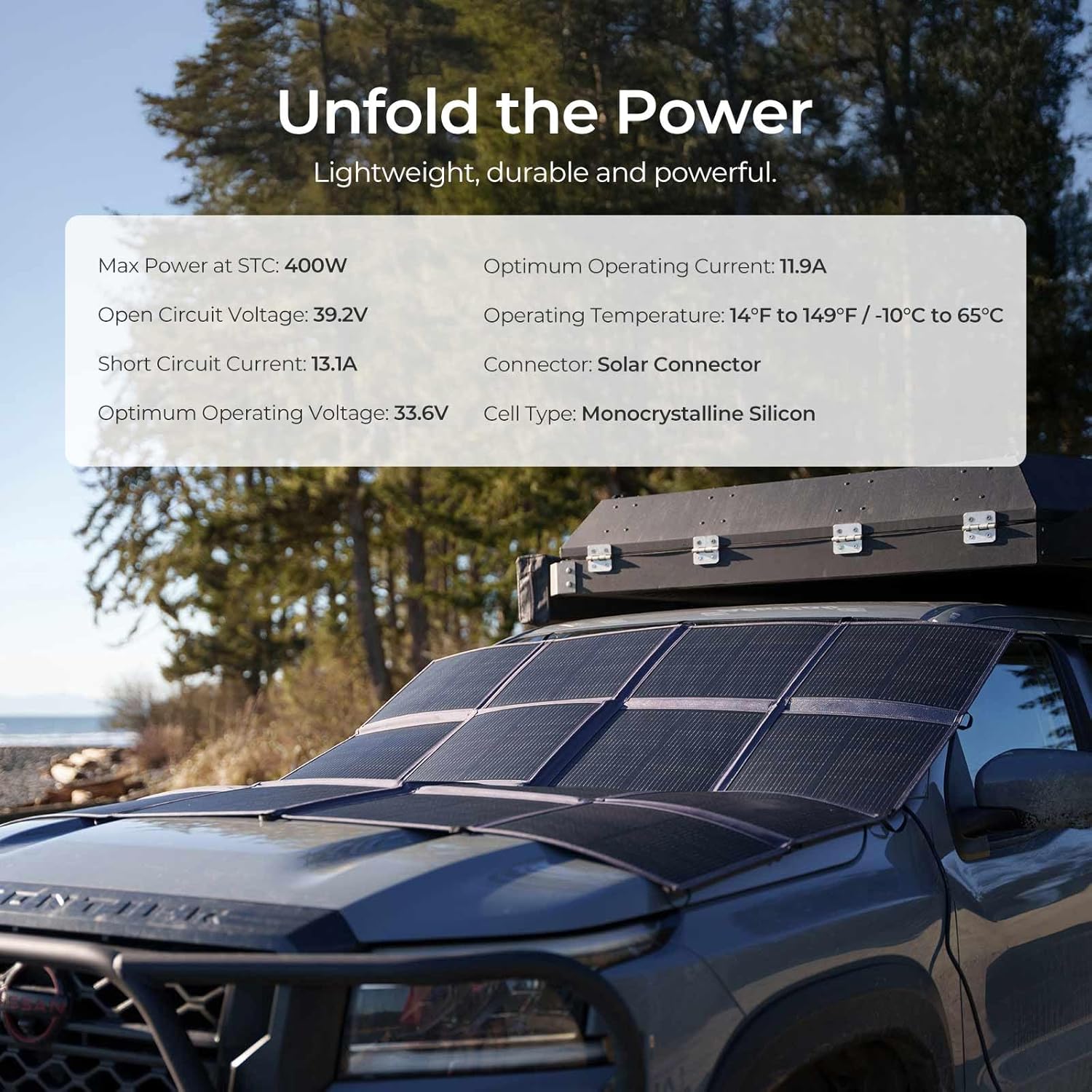
| Operating temp range | -10°C to 65°C |
| Durability | IP65, ETFE lamination, reinforced stitching |
| Warranty | 2-year material and workmanship |
Design and portability
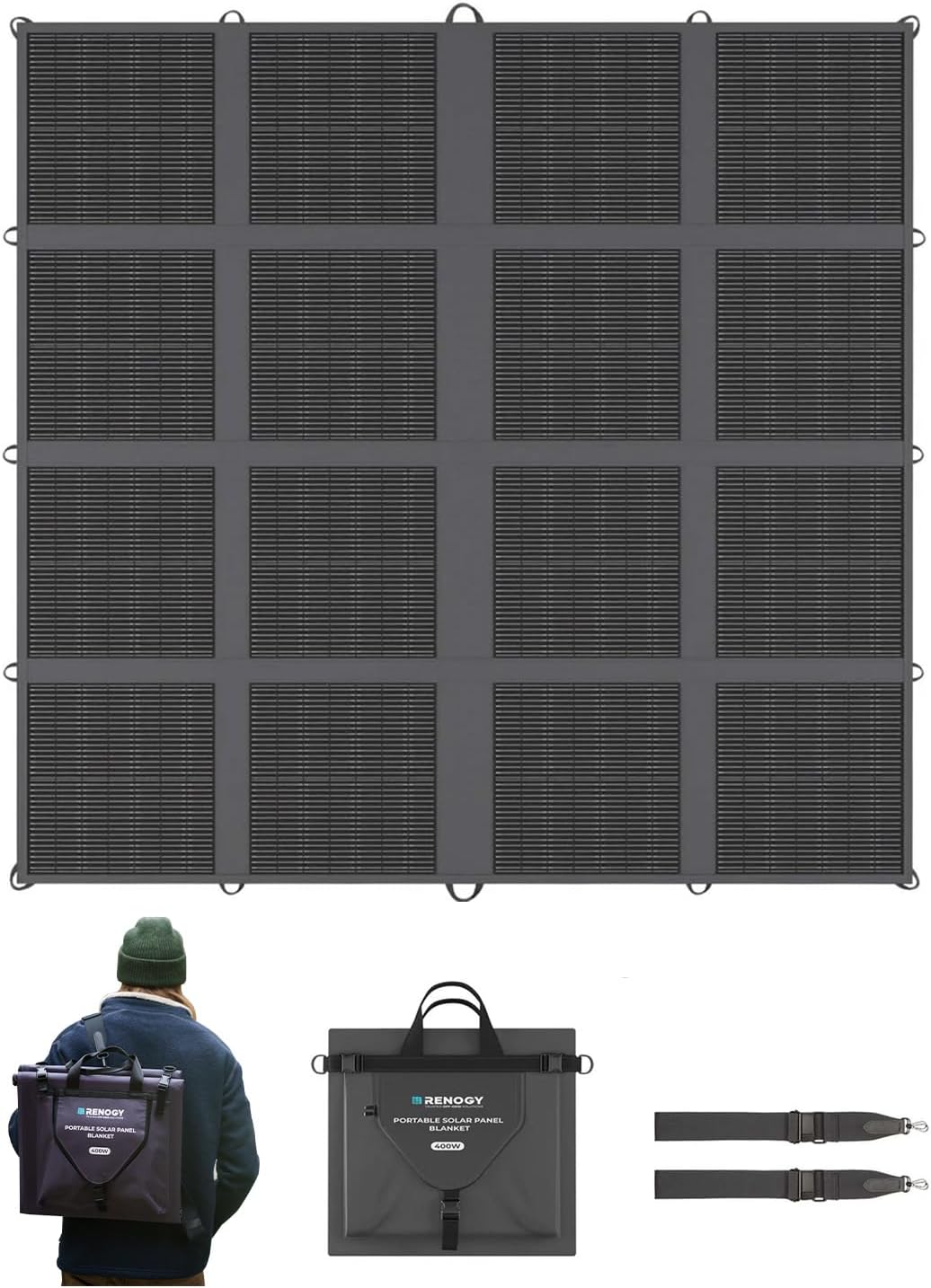
Renogy designed this panel to be an ultra-portable power source that doesn’t require a roof rack or large storage space. You get full 400W capability in a package that compresses to about backpack size, which is a practical benefit for vehicle-based camping and carry-in-camp use.
Folded size and weight
At just over 16 inches on the longest side and weighing 16.09 lbs, you can carry this panel by hand or toss it into a vehicle with little fuss. That size and weight make it suitable for one-person handling and for stowing in tight spaces inside SUVs, the back of a pickup, or in a van.
Carrying and transport
You’ll appreciate the padded handle and adjustable shoulder straps included for transport, which help when you’re moving between campsites or setting up on a trail. The compact fold also makes it easy to fit under or behind other gear — practical when space in the vehicle is at a premium.
Solar performance and efficiency
The Renogy blanket uses N-Type cells and 16 busbar architecture to boost cell-to-module efficiency up to 25%, which means more energy harvested from the same footprint compared with many other flexible or foldable designs. Efficiency matters especially when you have limited sun exposure or a small area to deploy panels.
25% N-Type cell efficiency explained
N-Type silicon and more busbars reduce recombination losses and improve low-light performance, so you’ll typically get more usable power per hour than with older P-Type or standard 9BB designs. Practically, that translates to faster charging in marginal conditions and better output when the sun is low in the sky.
Real-world output and charging estimates
Although the panel is rated 400W peak, actual output varies with sun angle, shading, temperature, and the quality of your charge controller. Under ideal midday sun you can get near peak output, but typical real-world average might be 50–80% of peak across a sunny day depending on location and season.
| Battery / Power Bank | Typical capacity | Estimated solar input time (ideal sun) | Realistic daily harvest (sunny day) |
|---|---|---|---|
| Small power station | 300–500 Wh | 1.5–3.0 hours to full (if MPPT and low losses) | 1,200–2,400 Wh/day |
| Mid-size station | 1000 Wh | 3–6 hours to full | 1,500–3,200 Wh/day |
| Large station / battery bank | 2000 Wh | 6–10+ hours to full (may need multiple days) | 2,000–3,600 Wh/day |
These are estimated ranges to give you a practical sense of charging. You should expect longer charge times if skies are partly cloudy, the panel is not optimally oriented, or you’re using a charge controller or inverter with inefficiencies. Always pair the panel with a good MPPT charge controller when charging batteries directly to maximize the input and reduce charge time.
Installation and mounting options
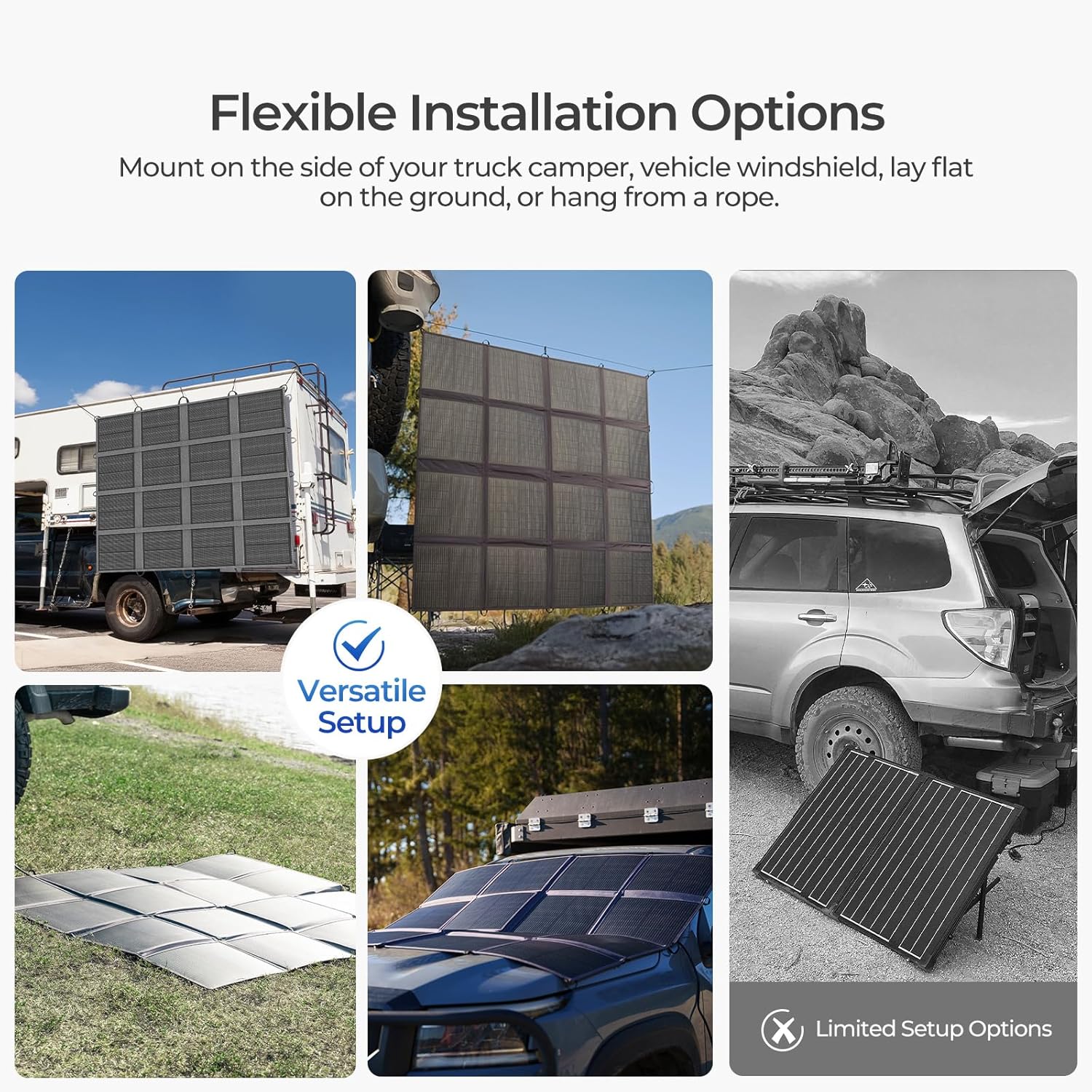
You have multiple ways to deploy this blanket depending on your vehicle, campsite layout, and shade needs — laying it across a windshield, placing it on flat ground, or hanging it between trees are all valid and practical. The panel is designed to deliver its full 400W regardless of orientation, though optimal positioning still matters for best hourly output.
Laying across a windshield for shade and charging
If you park with the sun in front of your vehicle, you can drape the panel across the windshield to create shade while it charges your station or battery. This setup is convenient and offers a dual function: it keeps your cab cooler and captures sunlight without needing ground stakes or racks.
Ground deployment and hanging
When your vehicle is in shade or uneven terrain makes lay-flat placement tricky, set the panel on nearby sunny ground or hang it vertically between trees or rack mounts. Hanging vertically can be especially good when the sun is lower in the morning or late afternoon and you want to catch oblique sunlight.
Connecting to power stations and batteries
The blanket ships with a 10 ft cable that plugs into most portable power stations or battery setups with the right adaptor. When you connect to a battery, you should use an MPPT charge controller for best performance, and when charging a power station follow the manufacturer recommendations to avoid exceeding input limits on the station.

Durability and weather resistance
Renogy has built this panel to handle outdoor conditions while staying lightweight — the ETFE lamination and reinforced stitching protect the cells and seams, and the flexible construction reduces the risk of hidden cracks. It’s rated IP65 for water and dust resistance, which makes it usable in damp conditions but not designed for prolonged submersion.
Materials: ETFE lamination and reinforced stitching
ETFE is a tougher, UV-resistant lamination that keeps the cell surface protected while adding mechanical resilience compared to standard PET laminations. The reinforced stitching helps prevent seam failures and reduces stress at fold points, which is a common weak spot on less robust blankets.
Operating temperature and IP65 rating
You can operate the panel between -10°C and 65°C, which covers most climates and seasons you’re likely to encounter on trips. The IP65 rating protects against water jets and dust ingress but does not make the unit waterproof for immersion, so avoid leaving it submerged or in a stream.
Practical use cases
This blanket fits a wide variety of situations where you need flexible, portable solar power without permanent mounting — think weekend camping, overland trips, boat days, emergency power during outages, or supplementing an RV roof array. Your mobility and varying deployment spots make the foldable format especially valuable, because you can change orientation and placement quickly.
Camping and overlanding
On a campsite or overland trip you’ll appreciate being able to park, set the blanket on the ground or hang it, and start charging a power station within minutes. It also gives you space-saving advantages inside a vehicle: if you need to store other gear you won’t lose a large rigid panel to roof or bed space.
RVs, boats, and truck beds
For RV or marine use you can use the blanket as a temporary supplement to roof panels or a backup when you’re anchored or parked in a shady spot. On a pickup bed or camper shell it’s easy to deploy and remove for overnight stays or day trips without permanent installation hardware.
Emergency backup and home use
In a blackout you can deploy the blanket to keep essential electronics and small appliances running via a power station, or use it to maintain a battery bank for lights and medical devices. It’s compact enough that you can store it in a closet or garage and deploy it quickly when needed.
Pros and cons
You’ll find a mix of strong benefits and a few trade-offs depending on how you plan to use the blanket. Below are the main strengths and limitations to consider so you can decide whether it matches your power needs and use style.
The pros and cons give you a quick sense of fit without overselling the product.
Pros:
- Very lightweight and compact compared to rigid 400W arrays.
- High cell efficiency (25%) yields more energy per square foot.
- Multiple deployment methods: windshield, ground, hanging.
- Robust build: ETFE lamination, reinforced stitching, IP65.
- Comes with long 10 ft cable and easy carry features.
- Good for varied users: campers, overlanders, marine users, emergency prep.
Cons:
- Flexible panels are generally less rigid and can need careful handling to avoid folding stress points.
- IP65 is splash proof but not waterproof; avoid immersion.
- Real-world output depends heavily on sun angle and shading — may need larger array or multiple panels for continuous heavy loads.
- You’ll want an MPPT charge controller or compatible power station to get the most out of it, which may be an additional cost if you don’t already own one.
Maintenance and care
Taking care of the blanket will keep its efficiency and lifespan maximized, especially because foldable panels can be vulnerable at seams and fold lines. Simple cleaning and proper storage go a long way to avoiding premature wear.
Cleaning and storage tips
Clean the panel with a soft brush or cloth and mild soapy water; avoid abrasive cleaners and harsh chemicals that can damage the ETFE lamination. When storing, make sure it’s dry and folded along the designed seams — store in a cool, dry place and avoid heavy loads on top of the folded blanket.
Troubleshooting common issues
If you’re seeing lower-than-expected output first check orientation, shading, and cable connections, and ensure your charge controller or power station input is compatible and not limiting current. Look for visible rips, worn stitching, or delamination at the folds; small issues can sometimes be repaired but major seam or cell damage may require contacting Renogy under the 2-year warranty.
Comparison with alternatives
If you compare this blanket to rigid 400W panels or smaller foldable arrays, you’ll notice the biggest differences are weight, packability, and cell efficiency. Rigid panels might be more durable in fixed installations and sometimes cheaper per watt, but they’re heavier and need roof or frame mounting; the Renogy blanket favors mobility and quick setup.
How it stacks up vs rigid 400W panels
Rigid 400W panels typically weigh much more and require permanent mounting hardware, which makes them great for long-term rooftop installations but less desirable for temporary trips. The blanket trades off a bit of mechanical rigidity for the ability to reposition and carry it easily, and in many cases the N-Type cells close the gap on energy production per footprint.
How it compares to other foldable or blanket-style panels
Compared to other blanket-style panels you’ll likely see improvements in packing size, weight, and cell efficiency thanks to the 16-fold design and 16BB N-Type cells. If you need the lightest, most compact option with relatively high output, this is one of the more advanced designs available.
Installation tips and best practices
You’ll get better performance and longer life if you take a moment to orient the panel properly and use the correct accessories. Small steps like using an MPPT controller and avoiding tight creases will pay off in daily energy harvest and longevity.
Orientation and tilt
Whenever possible, angle the panel so it faces the sun more directly during peak sunlight hours, and adjust the tilt for seasonal sun path changes. If you’re using ground deployment, a simple fold or props can give you an adjustable tilt that improves midday output significantly.
Wiring, charge controllers, and safety
Always use an MPPT charge controller when charging batteries directly because it will optimize voltage and current to deliver higher real-world power. Make sure connectors are secure and weather-protected; if you’re connecting to a power station, verify its input ratings so you don’t exceed manufacturer limits.
Who should buy this (and who might not)
If you’re mobile, value compact gear, and need a high-wattage solution without roof mounting, this blanket could be an ideal fit for your adventures. Conversely, if you want a permanent rooftop array for maximum durability or you need absolutely waterproof panels for submersion-prone marine tasks, a rigid panel or different marine-specific solution might be better.
Best match: campers, overlanders, day boaters, emergency preppers
You’ll benefit most if you regularly move between campsites or need a portable charging solution for a power station or battery bank. The ease of transport and set-up is especially helpful when you need flexible, temporary power.
Not ideal if you require permanent rooftop installations or full waterproofing
If you want a permanent rooftop solar system with maximum ruggedness and minimal manual setup, rigid panels permanently mounted to your roof or rack may serve you better. Similarly, if you need panels that can be submerged or endure continuous exposure to splashing saltwater without any risk, look for marine-grade rigid panels with higher waterproof ratings.
Value for money and warranty
You’re getting an advanced cell technology and a very portable format that could replace heavier systems or allow you to add significant charging capacity without a lot of extra hardware. The 2-year material and workmanship warranty provides reasonable coverage for an item that will see rugged field use, but keep in mind normal wear at fold points and seams is possible with heavy use.
Cost-benefit analysis
If you compare cost per pound and watt-per-square-foot, this blanket often makes sense if your priority is portability and quick setup rather than lowest price per watt. The 25% efficiency and foldable form factor provide tangible benefits that justify any premium over basic flexible panels.
Warranty and support considerations
Renogy’s 2-year warranty covers manufacturing defects and workmanship, so register your product and keep your purchase receipt if you plan to do heavy use in the field. For damage from misuse or extreme wear, you should anticipate that warranty coverage may not apply, so follow best practices with handling and storage.
Final recommendation
If you need a true portable 400W solution that balances weight, efficiency, and deployability, the Renogy 400W Portable Solar Panel Blanket is an excellent choice for most mobile power needs. You’ll get a solid combination of high-efficiency N-Type cells, compact folding design, and rugged materials that make day trips and extended off-grid stays more convenient and productive.
Quick buying checklist
Before you purchase, make sure:
- Your power station or battery system can accept the panel’s voltage and current (or you have an MPPT controller).
- You have a plan for where you will deploy the panel and whether you need extra mounting accessories.
- You’re comfortable treating foldable panels with slightly more care at fold seams compared with rigid arrays.
If those boxes are checked, you’ll likely find this Renogy blanket to be a practical, high-performance addition to your off-grid toolkit — a lightweight way to add serious solar capacity without the headaches of permanent installation.
Disclosure: As an Amazon Associate, I earn from qualifying purchases.