
? Are you looking for a powerful, professional-grade HVLP system that gives you precise control, high transfer efficiency, and reliable durability for projects ranging from cabinetry to automotive finishes?

Quick Product Summary
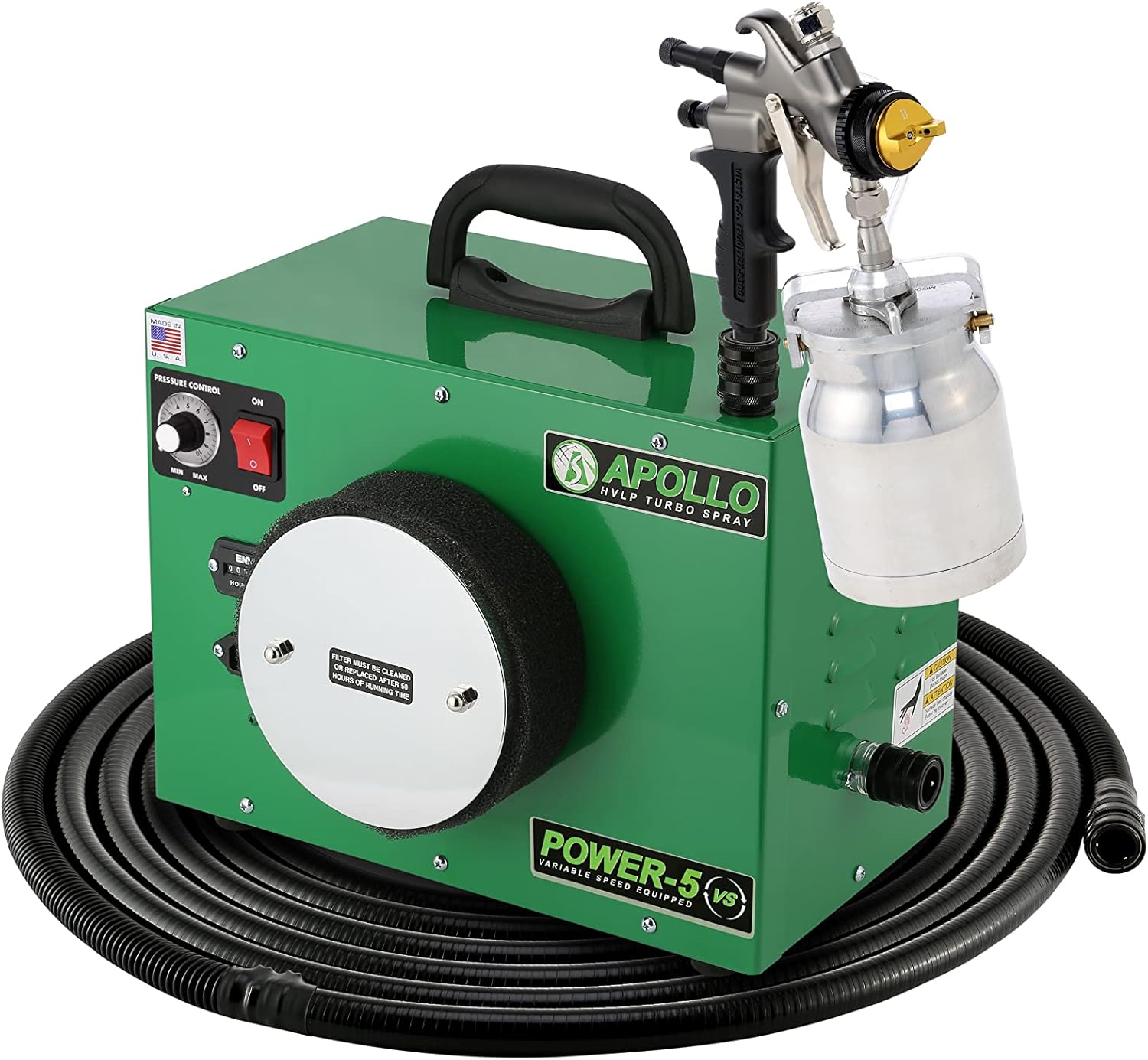
You’ll find the HVLP POWER-5 VS 5-Stage Turbo Paint System+7700QT Gun & 32′ Hose is built to give strong atomization and consistent output for demanding jobs. You can expect a combination of a 5-stage turbine and the 7700QT AtomiZer gun that targets reduced overspray, improved transfer efficiency, and flexible spray options.

HVLP POWER-5 VS 5-Stage Turbo Paint System+7700QT Gun & 32' Hose
What’s in the Box
You get more than just a turbine and a gun; this package includes tools and extras aimed at setup, maintenance, and getting you spraying sooner. Everything is shipped in a carry case and includes parts that many other kits omit.
Included Accessories
The kit arrives with a 1-qt bottom feed 7700QT AtomiZer spray gun that has a 1.0 mm needle/nozzle set, a stainless-steel material filter, spare parts, and a sample bottle of Apollo gun lube. You also get a 32-foot hose, cleaning kit, viscosity meter, turbine blow-off tool, wrench, carry case, and an hour use meter to monitor maintenance intervals.
| Included Item | Purpose |
|---|---|
| 5-stage HVLP turbine unit | Primary air source and atomization power |
| 7700QT AtomiZer 1-qt gun (1.0 mm) | Main spray gun for finishing |
| 32′ hose | Flexible connection to reach work areas |
| Stainless steel material filter | Keeps foreign matter out of the gun |
| Spare parts kit & wrench | Field replacements and adjustments |
| Sample Apollo gun lube | Lubrication for moving parts |
| Viscosity meter & cleaning kit | Paint prep & post-spray cleaning |
| Turbine blow-off tool | Quick blow-dry and cleaning aid |
| Carry case | Transport and storage |
| Hour use meter | Maintenance tracking |
| Limited 2-year warranty | Manufacturer support and protection |
Specifications
You’ll want to know the core specs and what they mean for your work. The key figures are the 5-stage turbine, variable speed motor control, 130 CFM output, and the gun’s bottom-feed 1-qt cup configuration.
Performance Specifications
The turbine operates at 110VAC, 60Hz and offers a sealed 10.0 PSI rating with a peak air volume of roughly 130 CFM (approx. 3.68 cmm). You’ll appreciate the variable speed control that lets you dial atomization and flow to suit fine lacquers or heavier gelcoat and faux finishes.
| Specification | Detail |
|---|---|
| Power | 110VAC 60Hz |
| Turbine stages | 5-stage |
| Air output | 130 CFM (~3.68 cmm) |
| Sealed PSI | 10.0 PSI |
| Gun model | 7700QT AtomiZer, 1-qt bottom feed |
| Needle/nozzle | 1.0 mm set included |
| Filter | Stainless steel material filter |
| Hose length | 32 feet |
| Extras | Viscosity meter, cleaning kit, blow-off tool |
| Origin & warranty | Made in USA, limited 2-year warranty |
Design and Build
The system’s physical build balances portability and workstation reliability so you can move around a shop without sacrificing performance. You’ll notice a sturdy housing, anti-vibration feet, and multiple vents to help keep the motor cool during extended runs.
Turbine Housing and Venting
There are 26 vents integrated into the turbine housing to improve cooling and extend motor life by controlling internal heat. You’ll also appreciate dual air filters that protect moving parts and maintain consistent airflow under heavy use.
Mounting and Mobility
A docking station for the gun is included on the turbine, giving you a secure place to park the gun between coats. You’ll find the carry case and thoughtful layout help if you need to transport the unit between job sites.
Turbine & Motor Features
You can adjust the turbine output with brand-new variable speed motor control to match material viscosity and desired finish. The 5-stage design gives the torque and continuous air volume necessary to atomize thicker materials that single-stage units struggle with.
Cooling and Longevity
Dual air filters plus the 26 vents help keep the motor stable during long painting sessions so you can focus on finish quality. The anti-vibration feet reduce wear and tear on internal components while keeping the unit quieter and steadier on your workspace.
Monitoring and Maintenance Tools
An hour use meter is built in so you can track runtime and schedule maintenance based on actual usage rather than guesswork. You’ll find this especially handy when you’re running frequent or long projects and need predictable performance.
7700QT AtomiZer Spray Gun
The included 7700QT AtomiZer gun is designed to give you a lot of flexibility: it can be used as bleed or non-bleed, is turbine and air-compressor compatible, and has microtech atomization for a smooth pattern. You’ll like that it includes a 1-qt bottom feed cup so you can spray longer between refills.
Gun Controls and Adjustability
You get fan pattern control and a material adjustment knob so you can fine-tune the spray for edge control, overlap, and reduced runs. The gun’s design emphasizes precision overspray control, which helps your transfer efficiency and reduces waste.
Nozzle and Filtration
The 1.0 mm needle/nozzle is great for a broad array of coatings, and the stainless steel material filter keeps debris from reaching the needle and tip. You’ll benefit from the included spare parts kit and wrench for quick nozzle swaps and on-site repairs.
Setup and First Use
You’ll want to run a few setup checks before you start spraying to ensure a clean, consistent finish and to avoid avoidable clogging or poor atomization. Basic prep includes checking filters, hooking up hoses, and running the turbine at a moderate speed with water or solvent to purge any manufacturing residue.
Step-by-Step Startup
- Place the turbine on a stable, level surface and attach the anti-vibration feet.
- Connect the 32′ hose to the turbine and the gun using the provided fittings and check for secure seals.
- Fill the gun’s 1-qt cup with a test fluid and run the turbine at low speed to confirm airflow direction and pattern control.
- Gradually increase speed until you achieve the desired atomization, then test spray on cardboard to fine-tune material and fan adjustments.
You’ll want to follow these steps to avoid surprise hiccups once you start working on your actual project.
Safety and Ventilation
You should always wear appropriate respiratory protection and ensure adequate ventilation, particularly with solvent-based coatings and thicker materials. You’ll also want to ground both turbine and compressor lines properly if you’re working in an environment with static-sensitive materials.
Paint Types and Compatibility
You can use this system with many different coatings: lacquers, enamels, urethanes, varnishes, stains, primers, and even tougher materials like gelcoats and custom faux paints. You’ll find the 5-stage turbine helps atomize thicker coatings more effectively than single-stage systems.
Best Applications
This kit is especially good for cabinet finishing, furniture, architectural trim, marine gelcoat patches, and custom decorative finishes that require low overspray and high-quality atomization. You’ll also get good results in automotive touch-up or panel work when you pair the turbine with suitable thinners and technique.
Materials to Avoid or Use with Care
For extremely particulate-heavy or ultra-high solids materials, you’ll need to strain thoroughly and possibly use a larger nozzle to prevent clogging. You should avoid spraying materials with particulate size larger than the nozzle capacity without appropriate filtration and thinning.
Thinning and Viscosity Guidelines
You’ll want to measure viscosity with the included meter and follow manufacturer recommendations for each material to get the best atomization. Thinning isn’t always necessary, but proper viscosity will make the difference between a smooth finish and runs, orange peel, or poor adhesion.
Using the Viscosity Meter
Use the included viscosity meter to compare your paint to recommended ranges and adjust with the appropriate reducer or solvent. You’ll find many manufacturers give a target range in seconds (Ford Cup, Zahn cup, etc.); match that to the meter and test spray before committing to the piece.
Typical Thinning Recommendations
For lacquers and most solvent-based coatings you may only need minimal thinning, while urethanes and high-solid enamels often need more reducer to atomize cleanly. You’ll want to note that gelcoats and heavy faux-paint mediums may require a specific approach: slower turbine speeds, larger nozzle sizes, and thicker passes.
Spray Techniques and Settings
Your technique matters as much as the equipment: consistent gun movement, appropriate overlap, and correct distance yield the best finishes. You’ll be able to tailor pattern shape and material flow with the gun’s fan and material knobs to match panel size, ambients, and material behavior.
Optimal Distance and Speed
Keep the gun 6–10 inches from the surface for fine finishes and closer if you’re using larger nozzles or thicker materials. You’ll want to maintain a steady, overlapping pass of about 50% overlap to avoid streaks and ensure even coverage.
Adjusting for Different Projects
For large flat surfaces like cabinets, you’ll prefer a wide fan at moderate flow; for trim and detail work, narrow the fan and reduce flow for more control. You’ll also use lower turbine speeds for delicate finishes and higher speeds for quick coverage of thicker coatings.
Transfer Efficiency and Paint Savings
One of the big selling points is the high transfer efficiency ranging between 80% and 90% under the right conditions, which can translate into up to 40% or more paint savings. You’ll save money and reduce cleanup and overspray compared to traditional air-compressor guns without HVLP control.
How Efficiency Is Achieved
The 5-stage turbine provides consistent air volume that matches the gun’s atomization characteristics, helping paint particles reach the target rather than float away as overspray. You’ll find that correct tuning—pressure, nozzle size, fan—combined with the gun’s pattern control, makes the greatest difference.
Realistic Expectations
Your results will depend on material type, environmental conditions, and technique; those 80–90% figures are achievable with lacquer-like materials and controlled conditions, but certain high-solid coatings may deliver lower real-world savings. You’ll want to run tests and adjust settings to get optimal results specific to your material and environment.
Cleaning and Maintenance
You should clean the gun after every use to prevent build-up and protect the needle/nozzle. Regular maintenance of the turbine—checking filters, monitoring the hour meter, and keeping vents clear—will keep the system running smoothly over its lifespan.
Daily Maintenance
After each use, flush the gun cup and fluid passages with appropriate cleaner, disassemble and clean the nozzle and needle, and store the gun lubricated with the sample Apollo lube. You’ll also inspect the hose and connections for wear or cracks.
Scheduled Maintenance
Use the hour meter to schedule deeper maintenance such as filter replacement, turbine internal checks, and inspection of the motor and bearings. You’ll prolong the unit’s life by replacing filters before they’re heavily clogged and by ensuring vents remain free of dust and paint build-up.
Troubleshooting Common Issues
If you experience poor atomization, runs, or sputtering, you’ll likely resolve most issues with a few checks: clean filters, inspect nozzle/needle, re-check viscosity, and ensure proper turbine speed. Many small issues come down to clogged filters or incorrect thinning.
Quick Troubleshooting Steps
- Sputtering: check material filter and fluid passages for clogs and verify cup venting.
- Heavy droplets/poor atomization: increase turbine speed or thin material; inspect nozzle size.
- Excessive overspray: reduce fan size and lower material flow; increase overlap and shorten distance.
You’ll find that systematic checks quickly get you back to good performance.
| Problem | Likely Cause | Quick Fix |
|---|---|---|
| Sputtering | Clogged filter, air leak, empty cup | Clean filter, check seals, refill cup |
| Orange peel | Viscosity too high, low turbine speed | Thin material, raise turbine speed |
| Running or sagging | Too much fluid flow | Reduce flow, increase fan or distance |
| Inconsistent fan pattern | Damaged nozzle or needle | Replace nozzle/needle, check alignment |
| Excessive overspray | Fan too wide or high turbine speed | Narrow fan, adjust speed, technique |
Comparisons to Other Systems
You’ll want to compare this 5-stage turbine HVLP system to single-stage turbines and traditional compressor/pressure pot setups. The POWER-5 VS stands out for thicker-material atomization and portability compared with single-stage units, while avoiding the complexity and overspray of conventional compressor-and-regulator setups.
Advantages over Single-Stage HVLP Turbines
Compared with single-stage turbines, the POWER-5 VS gives you higher and steadier airflow for materials that need more energy to atomize. You’ll notice better finish quality on higher-viscosity coatings and fewer passes required to achieve coverage.
Differences from Compressor-Based Systems
Compressor-driven guns can give more instantaneous power but at the cost of higher overspray if not carefully regulated; plus, compressors are often noisier and less portable. You’ll get quieter operation, less overspray, and integrated control with the turbine system, although extreme production settings might still prefer a commercial compressor and pressure pot.
Pros and Cons
You’ll want a balanced view before deciding. The system brings professional-level features and many useful accessories, but it is heavier and pricier than entry-level HVLP kits and still requires proper technique to reach those headline transfer efficiencies.
| Pros | Cons |
|---|---|
| 5-stage turbine for thick materials | Larger and heavier than single-stage units |
| Variable speed motor control | Higher initial cost than basic kits |
| 7700QT AtomiZer gun (bleed/non-bleed) | Requires practice to maximize savings |
| High transfer efficiency (80–90%) | Some coatings may still need a compressor approach |
| Includes cleaning kit, viscosity meter, blow-off tool | 32′ hose is long—can be unwieldy in small spaces |
| Made in USA + 2-year warranty | Replacement parts and consumables add ongoing cost |
Practical Advantages
You’ll get a system that’s ready for a range of jobs and often includes what you need to start right away, like a cleaning kit and viscosity meter. The 2-year warranty gives you additional coverage and peace of mind for professional or heavy amateur use.
Considerations Before Buying
You should think about storage space and transport, as a 5-stage turbine is bulkier and a 32′ hose needs proper care to avoid kinks and damage. You’ll also want to budget for consumables like replacement nozzles, filters, and solvent for cleaning.
Who This Is Best For
You should consider this system if you regularly spray medium-to-high-viscosity materials or you work on cabinetry, furniture, marine gelcoat tasks, or professional auto body panels. You’ll also appreciate the portability and accessory kit if you travel to jobs or need a single-package solution.
Not Ideal For
If you only occasionally spray thin lacquers on small crafts, a smaller single-stage HVLP or a gravity-feed cup gun might be more cost-effective and easier to store. You’ll want to match your investment to frequency and material demands.
Cost of Ownership and Value
You’ll pay more up front for a 5-stage, feature-rich turbine than entry-level HVLP kits, but your paint savings, time savings, and improved finish quality may justify the purchase. Factor in consumables and potential replacement parts, but also the included extras that many packages sell separately.
Long-Term Savings
With advertised 40%+ paint savings in ideal conditions, you’ll likely offset part of the purchase if you’re doing consistent work over months or years. You’ll also save on cleanup and shop contamination thanks to reduced overspray.
Warranty and Support
A limited 2-year warranty backs the unit, and “Made in USA” manufacturing often means quicker access to parts and service. You’ll want to register the product and keep your hour meter logs to streamline any warranty claims.
Final Thoughts
You’ll find the HVLP POWER-5 VS 5-Stage Turbo Paint System+7700QT Gun & 32′ Hose is a solid choice for users who need serious atomization power, on-board accessories, and a flexible 1-qt gun for medium-to-large projects. If you invest time in learning the tuning, cleaning, and technique, you’ll get consistent, high-quality finishes and meaningful paint savings.
Recommendation Summary
If you do frequent finishing work, need to handle thicker coatings, and want a portable, all-in-one kit with professional features, this system is worth strong consideration. You’ll get a rugged turbine, a versatile gun, and a full accessory set that supports production work while keeping long-term operating costs down with improved transfer efficiency.
Disclosure: As an Amazon Associate, I earn from qualifying purchases.