
? Are you looking for a portable power solution that charges fast, lasts long, and works for home backup, camping, and RVs?

Quick verdict
You get a fast-charging, long-lived portable power station with a highly efficient bifacial solar panel. The EF ECOFLOW Solar Generator DELTA 3 with 220W Bifacial Solar Panel is designed to give you flexible charging options, expandability up to 5 kWh, and a battery chemistry (LiFePO4/LFP) that’s built to last for years of daily use. If you want a reliable backup that’s both portable and capable of powering multiple appliances at once, this system is a strong contender.
Key specifications
Below are the headline specs so you can quickly understand what this package offers. These numbers summarize the most important performance and charging characteristics you’ll care about when choosing a power station.
| Feature | Detail |
|---|---|
| Product name | EF ECOFLOW Solar Generator DELTA 3 with 220W Bifacial Solar Panel, 1024Wh Portable Power Station |
| Battery type | LiFePO4 (LFP) |
| Usable capacity | 1024 Wh (power station) |
| AC output (continuous) | 1800 W |
| AC surge / X-Boost capability | Manufacturer claims support for resistive loads over 2600 W with X-Boost |
| USB-C output | 100 W |
| Solar panel | 220W bifacial, N-Type cells, up to 25% conversion, up to +28% energy via bifacial rear capture |
| Solar input | Up to 500 W (combined input) |
| AC input (max) | 1500 W |
| Fast charge (combined) | Full charge in 56 minutes (500W solar + 1500W AC combined claim) |
| Solar-only charge | ~5.8 hours with one 220W panel, ~2.9 hours with two panels |
| Expandable capacity | Up to 5 kWh with compatible battery packs (DELTA 3, DELTA Pro 3, DELTA 2 Max) |
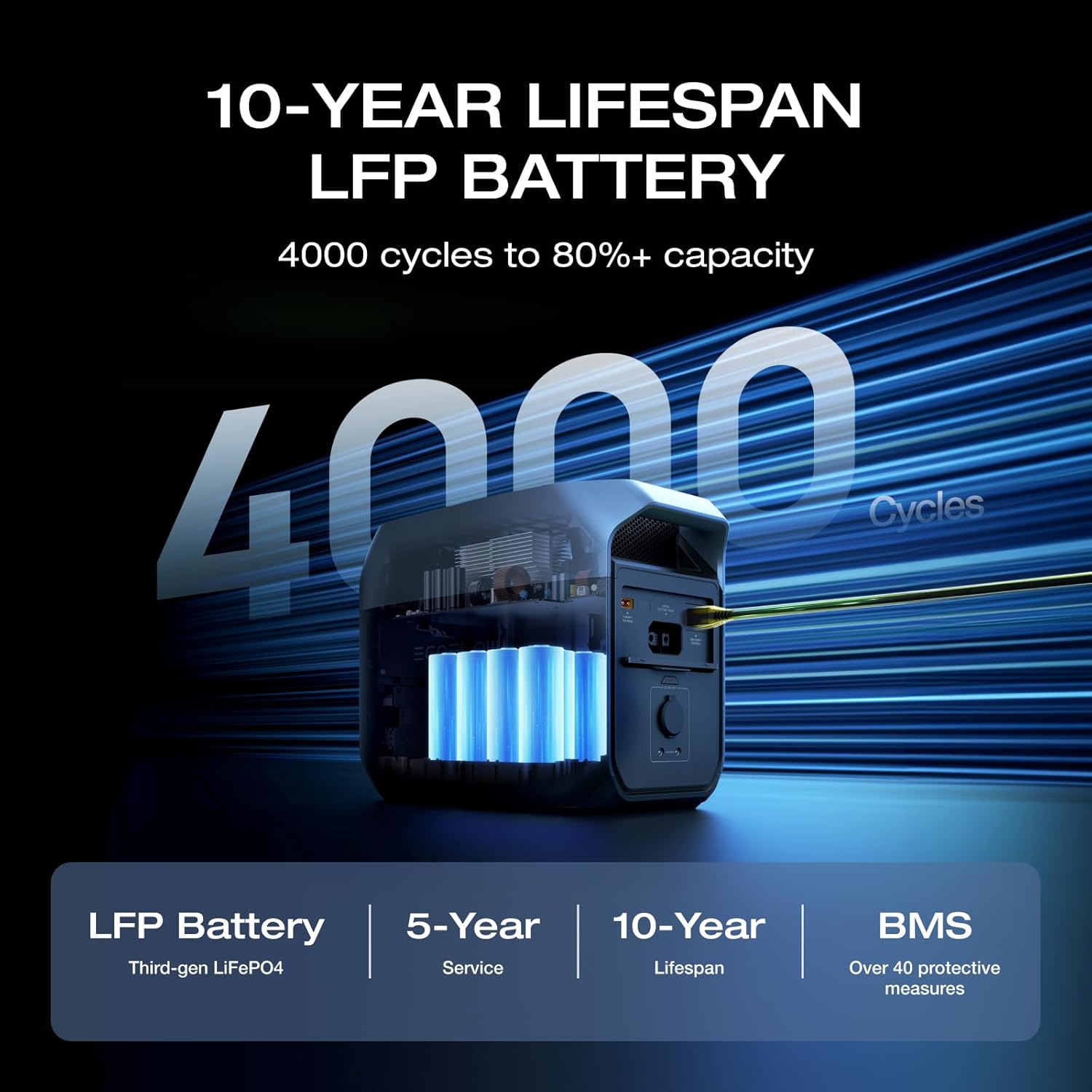
| Cycle life | Retains 80% capacity after 4000 cycles |
| Lifespan | 10-year design life for daily use |
| IP rating (battery pack) | IP65 (splash-proof, dust-proof, oil-proof) |
| Number of appliances supported simultaneously | Up to 13 (various ports) |
| Inclusions | DELTA 3 station, 220W bifacial solar panel, AC charging cable, MC4 to XT60i cable, protective bag, user manual, 5-year customer service |

What’s in the box
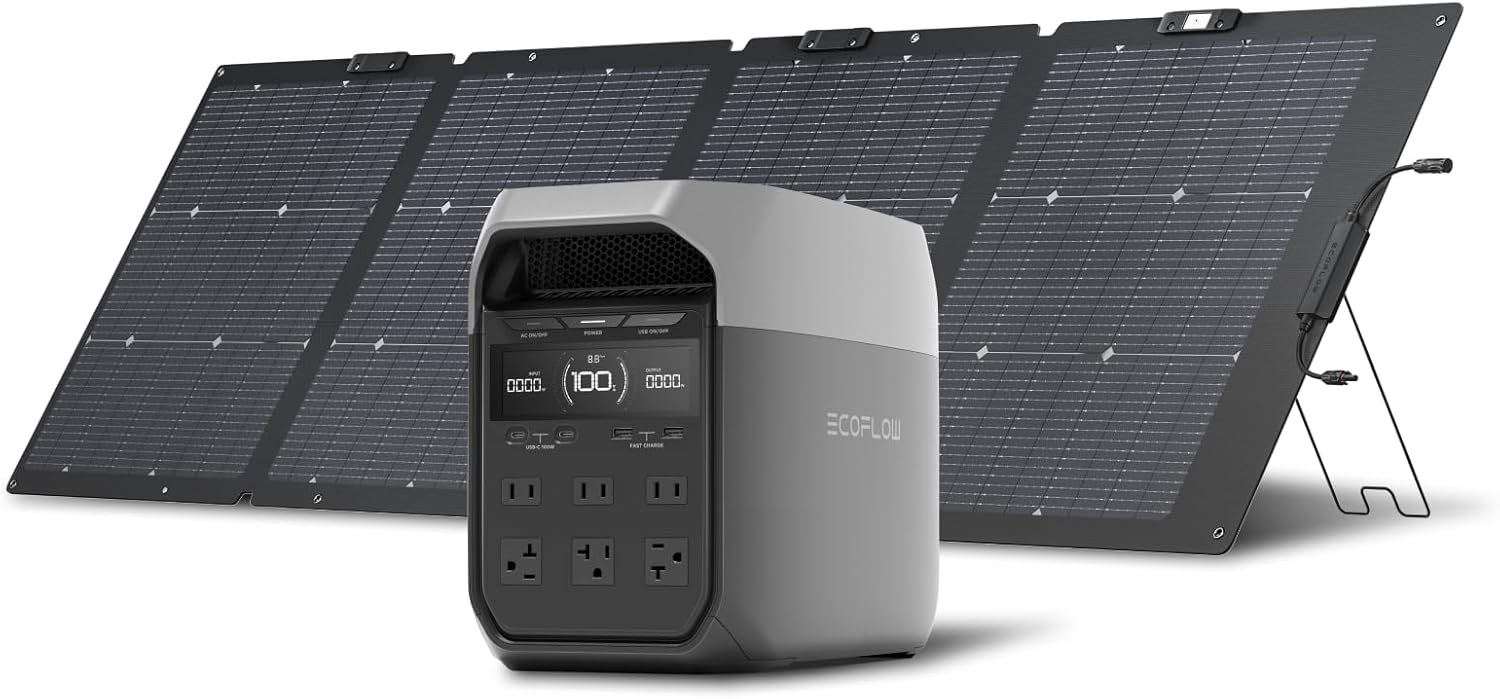
You’ll find everything needed to get started with a solar + battery setup, delivered in two packages for convenience. The main power station and the panel ship separately, but the bundle includes the essentials to connect and start charging. You also get the MC4-to-XT60i cable for solar panel connection and a protective bag for the panel or cables.
Design and build
The DELTA 3 looks and feels like a durable, purpose-built power station. You’ll see a blocky, utilitarian chassis that’s meant to be handled in outdoor or home backup scenarios, with a clear display and accessible ports. The 220W bifacial solar panel uses N-Type cells and a foldable design so you can set it up quickly when you arrive at camp or place it on a rooftop.
Power station layout and usability
The control panel is straightforward so you can switch outputs on/off and monitor input/output in real time. You’ll appreciate the simple display that shows battery percentage, input watts, and output watts so you won’t be guessing about remaining runtime. Buttons are intuitive and ports are grouped logically for easy access.
Solar panel construction
The solar panel uses N-Type cells for high conversion efficiency and a bifacial design that captures reflected light from the rear side, potentially boosting energy harvest by up to 28% under favorable conditions. The panel is compact for a 220W output and comes with a protective bag for transport. You’ll find folding seams and a handle for portability.
Battery and longevity
One of the most notable advantages of this system is the LFP battery chemistry. LiFePO4 batteries give you more charge cycles and better thermal stability compared with typical lithium-ion chemistries. This means you can use the DELTA 3 frequently without worrying about accelerated capacity loss.
Cycle life and long-term value
The DELTA 3’s LFP cells are rated to retain about 80% of their initial capacity after roughly 4000 cycles. For everyday use, that’s years — EcoFlow advertises a 10-year lifespan for daily use. You’ll likely find the long cycle life makes this a lower-cost-per-cycle option compared with many consumer power stations.
Durability and protection
The battery pack is IP65-rated, which gives you protection against splashes, dust, and oil. That doesn’t make it fully submersible, but it does make the DELTA 3 suitable for outdoor conditions including rainy weather, dusty job sites, and messy situations. You still should keep it sheltered from heavy downpours and submersion.
Charging performance
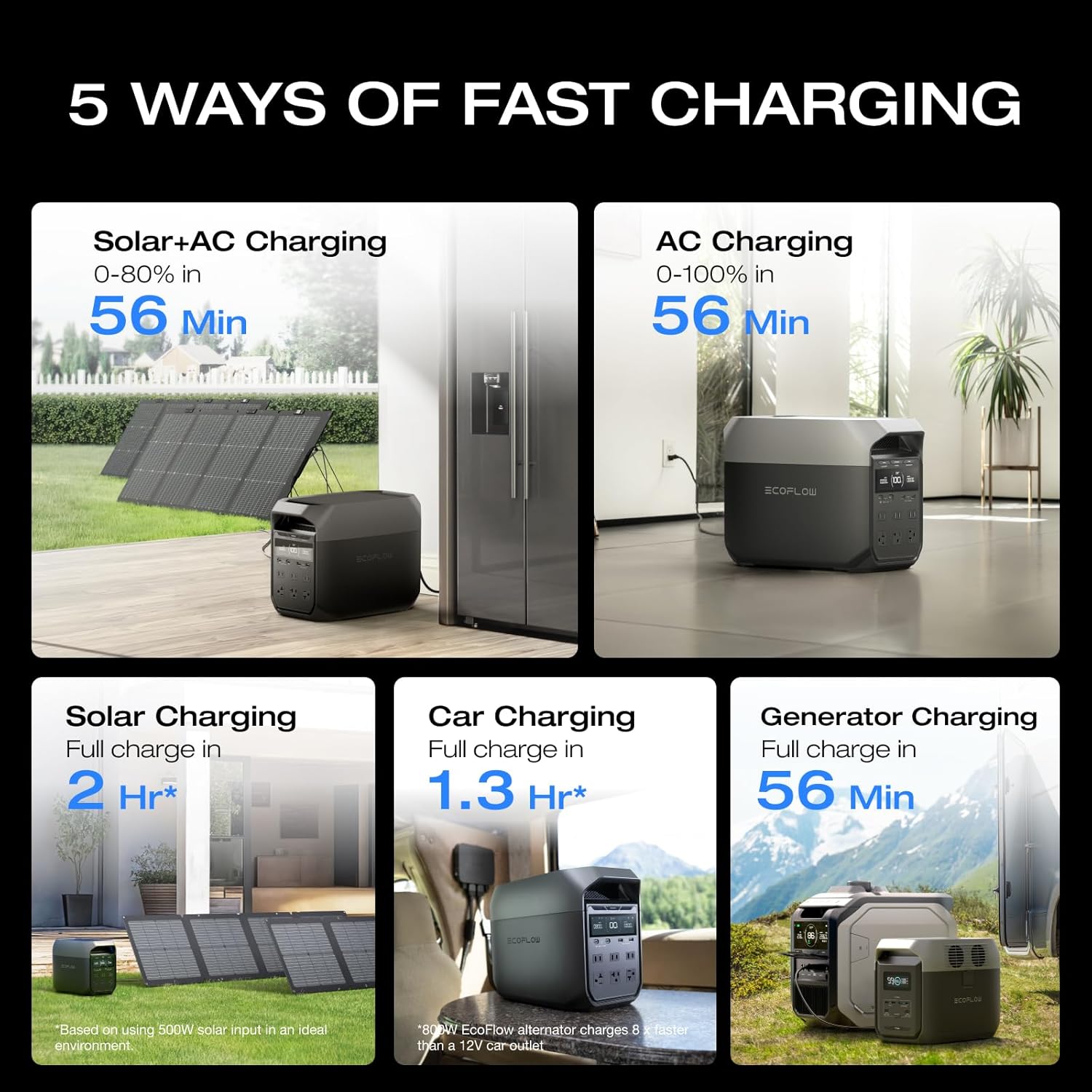
Fast charge is the headline feature here. EcoFlow advertises that, with their upgraded technology, a full charge can be achieved in 56 minutes when combining up to 500W of solar input with up to 1500W of AC input. In practical terms, you’ll see extremely fast AC charging and very usable solar charge rates with the included panel.
AC charging and rapid recharge
When plugged into AC, the DELTA 3 supports very high input power which translates into super-fast recharge times. The claim of “full charge in 56 minutes” relates to combining multiple inputs; even on AC alone you’ll find significantly shorter charge times than many alternatives. That’s especially valuable when you need quick turnaround between outages or at the start/end of a long trip.
Solar charging with the 220W bifacial panel
A single included 220W panel will fully charge the DELTA 3 in approximately 5.8 hours under ideal sun conditions. If you add a second 220W panel, the time drops to roughly 2.9 hours. The panel’s N-Type cells offer about 25% conversion efficiency, and the bifacial nature can add up to 28% more energy capture in the right setup — for example, when placed over reflective surfaces like sand or light-colored roofs. You’ll still want good direct sun for those quoted times.
Combined input and practical expectations
EcoFlow’s specs combine 500W solar input capability and 1500W AC input to hit the 56-minute full charge headline figure. In real-world scenarios you’ll want to consider sun intensity, temperature, and panel orientation. You’ll also see faster overall replenishment when you combine AC and solar inputs, which is useful if you need to top up quickly while still running loads.
Outputs, ports, and simultaneous use
You’ll find a generous selection of outputs on the DELTA 3, making it easy to run multiple devices at once. EcoFlow claims the unit can power up to 13 appliances simultaneously thanks to its array of AC outlets, USB ports, vehicle (12V) outputs, and more.
AC output and X-Boost functionality
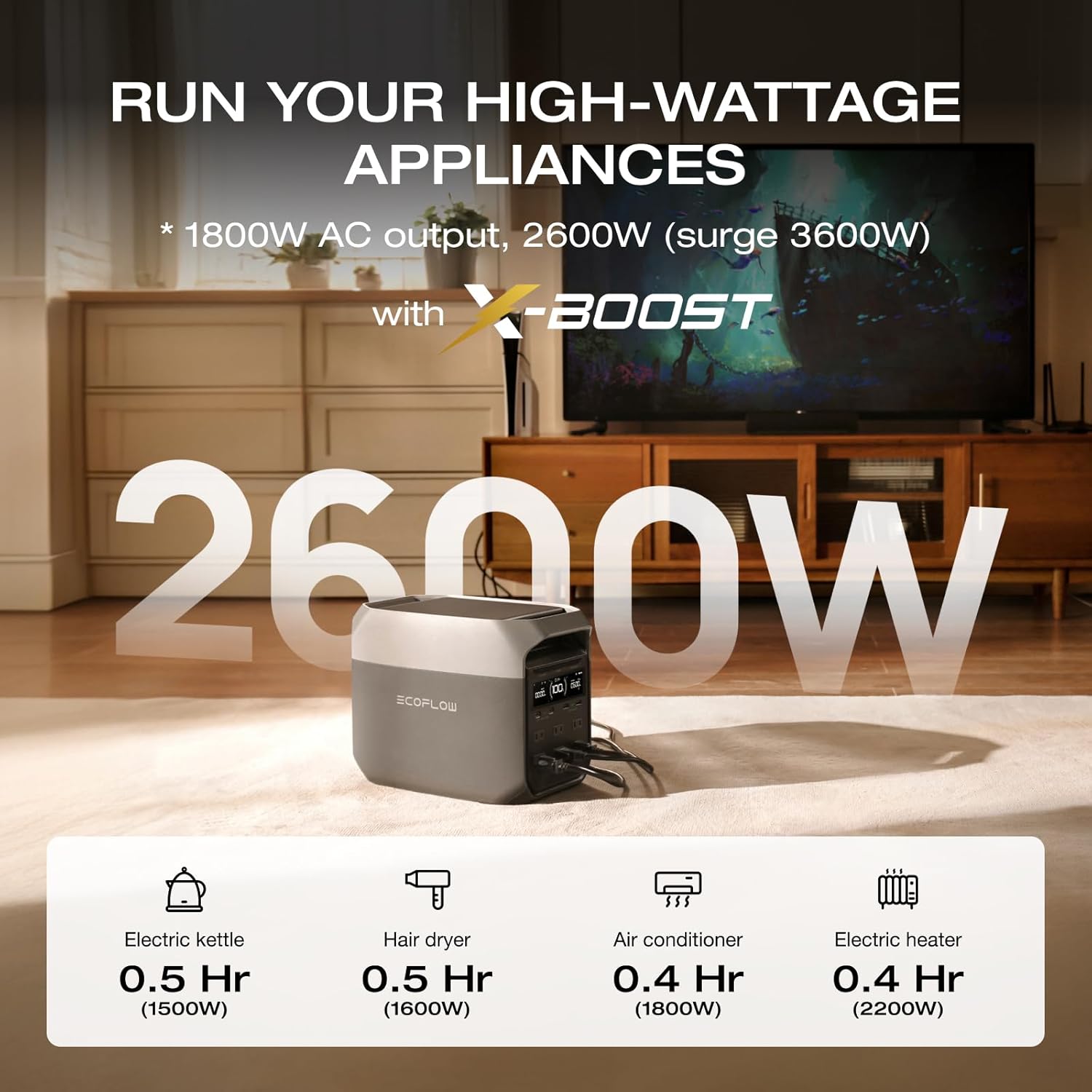
The DELTA 3’s normal continuous AC output rating is 1800W, which handles most household appliances like mini-fridges, fans, lights, and many power tools. EcoFlow’s X-Boost feature is marketed as supporting resistive appliances with power demands over 2600W continuously; in practice, X-Boost is intended to let the inverter run devices that exceed the nominal continuous rating by optimizing how power is delivered. You should test devices and read the manual to understand limitations and use X-Boost sensibly for short-term or specific workloads.
USB and DC outputs
You’ll get a 100W USB-C output for laptops and modern devices, plus multiple USB-A ports, car-style 12V outputs, and DC barrel jacks. That means you can charge phones, tablets, cameras, and run 12V accessories without relying on an AC inverter, which increases overall efficiency for low-power loads. You’ll appreciate the convenience of fast USB-C charging for newer laptops and phones.
Simultaneous output behavior
Because the DELTA 3 can support many wires and sockets at once, you can expect to run lights, a mini fridge, a laptop, and charge phones concurrently. The display shows total output power so you can avoid exceeding the continuous rating. Running multiple high-draw appliances will shorten runtime as you’d expect, so watch the total wattage to make the most of the battery.
Real-world run-time estimates
It helps to translate 1024 Wh into practical runtimes for everyday devices. Below is a table with rough estimates. These assume inverter efficiency and some overhead — use them as general guidance rather than precise guarantees.
| Device | Typical draw (W) | Estimated runtime from 1024 Wh |
|---|---|---|
| Smartphone (charging) | 10 W | ~80–90 full charges (many hours of standby) |
| Laptop (USB-C, 60W) | 60 W | ~12–14 hours |
| LED TV (30–60W) | 50 W | ~14–18 hours |
| Mini-fridge | 50–100 W (avg) | ~10–16 hours (compressor cycles) |
| Refrigerator (standard kitchen, 150–200W avg) | 175 W | ~4–5 hours |
| Portable AC (1000W) | 1000 W | ~1 hour |
| Coffee maker (temporary draw 800–1200W) | 1000 W | ~1 hour (short bursts) |
| Microwave (1000–1500W) | 1200 W | ~0.8 hour (short use) |
| Power tools (drills, saws; variable) | 500–1500 W | Depends on duty cycle; short bursts are okay with X-Boost |
These estimates account for a conversion/inverter efficiency factor and real-world usage patterns. For devices with motors or compressors, duty cycles (on/off patterns) matter a lot, and short bursts draw higher peak power but lower average power.
Use cases and scenarios
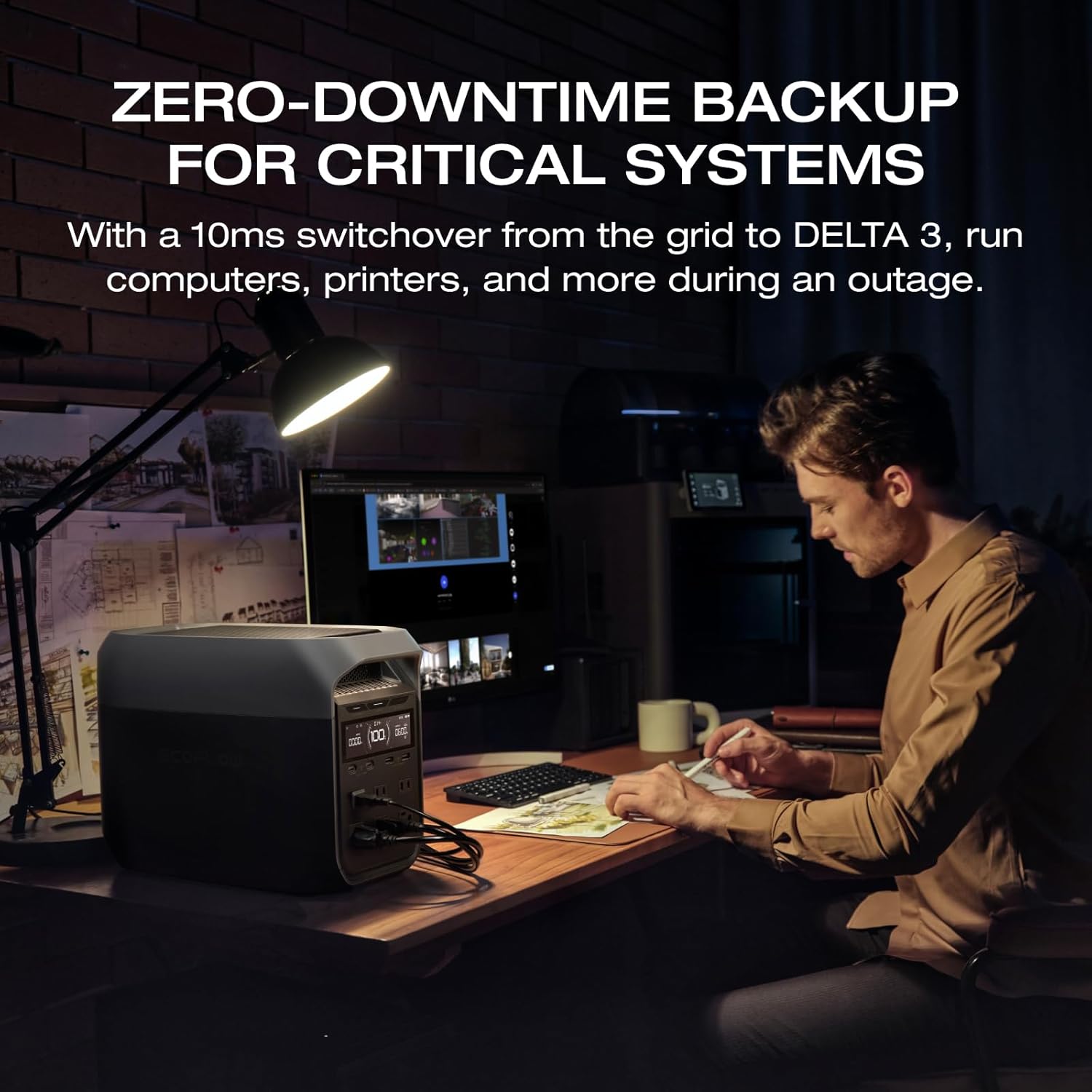
This generator package is built for flexible use. You can use it for home backup during outages, to power essentials while camping, to run appliances in an RV, or to support off-grid projects. The fast charging and expandability are major advantages if you want to scale capacity up later.
Home backup power
For temporary power during outages, you can keep lights, routers, medical devices, and a refrigerator running long enough to cover the worst of an outage. You can also chain extra battery packs if you need multi-day autonomy. You’ll want to prioritize loads and possibly add solar to cover longer outages.
Camping and RV use
The portable solar panel and compact power station are convenient for campsites and RVs. You’ll be able to charge phones, run small fridges, power lights and a coffee maker for short periods, and top up the system with solar during daytime. The included 220W panel and the potential to add another make fast solar replenishment practical.
Professional and off-grid tasks
The robust AC output and multiple outlets make this unit useful for job sites or outdoor events. You can power tools for short durations and use the system to support lighting rigs, sound gear, or camera setups. The LFP chemistry means you can cycle it daily for extended periods without losing capacity quickly.
Expandability and ecosystem
One of the DELTA 3’s standout features is expandability within EcoFlow’s ecosystem. You can add DELTA 3 extra batteries, DELTA Pro 3 or DELTA 2 Max battery packs to scale to up to 5 kWh total capacity. The extra battery for DELTA 3 is advertised as about one-third smaller and lighter than the DELTA 2 Extra Battery, making expansion more practical to carry and store.
When expansion makes sense
If you need multi-day power or want DC-coupled storage for frequent outages, adding extra battery packs will dramatically increase runtime. You’ll want to plan for where you’ll store and connect additional batteries if you anticipate regular extended outages.
Compatibility and integration
EcoFlow’s ecosystem approach means the DELTA 3 integrates with other EcoFlow battery packs and systems. That simplifies upgrades and ensures components are designed to work together safely and efficiently. You’ll get consistent charging and discharge management across the connected packs.
Portability and setup
While portable, the DELTA 3 is a substantial device designed to balance capacity and ruggedness. The foldable 220W panel helps keep transport manageable, and the included protective bag is handy. Setup is straightforward: unfold the panel, connect via the MC4-to-XT60i cable, and start charging. For AC charging, plug into a wall outlet; for faster recharge combine inputs as needed.
Moving and carrying tips
You’ll want to use both handles, or get help, if you’re moving the power station across uneven terrain. Keep the solar panel folded and in the bag when transporting to protect the cells. For camping, set the panel on a flat surface angled toward the sun and consider reflective surfaces beneath to take advantage of bifacial gain.
Safety and maintenance
EcoFlow designed the DELTA 3 with safety in mind; the LFP chemistry reduces risks of thermal runaway and improves stability. The unit includes battery management controls and protections for overcurrent, overcharge, and short circuits.
Routine maintenance
Keep the unit clean, dry, and charged periodically if you store it long-term. If you’re storing for months, aim to leave it around 40–60% charged and top up every few months to preserve battery health. Keep connectors corroded-free and store the panel in its bag to protect the cells.
Safety recommendations
Don’t allow the unit to be submerged and avoid extreme heat or cold for prolonged periods. Use only the supplied or compatible cables and follow the manual for X-Boost usage because pushing devices beyond nominal ratings can stress components. Always monitor loads when running high-power devices.
Pros and cons
Here’s a straightforward look at major strengths and limitations so you can quickly see whether the DELTA 3 fits your needs.
Pros:
- Extremely fast charging when combining solar and AC inputs.
- Long-lived LFP battery chemistry with ~4000-cycle life and 10-year design expectancy.
- Expandable up to 5 kWh for extended off-grid use.
- 220W N-Type bifacial solar panel with high efficiency and potential rear-side gain.
- IP65 battery pack for better outdoor durability.
- Wide selection of ports including 100W USB-C.
- Ability to power many devices simultaneously (up to 13 interfaces).
Cons:
- Real-world full-charge timing depends on ideal conditions; 56 minutes is a best-case combined input scenario.
- Continuous AC output rated at 1800W, which may limit certain high-draw appliances without careful management or X-Boost use.
- The unit is substantial — not as light as the smallest consumer power banks — so portability is situational.
- Bifacial gains depend heavily on ground reflectivity and panel placement.
How it compares to other options
Compared with many consumer portable power stations, the DELTA 3 stands out for rapid charging, LFP longevity, and the included high-efficiency bifacial panel. If you prioritize fast recharge and long cycle life, this system is a better fit than many lower-cost Li-ion options. If ultra-lightweight portability or extremely low price is your priority, smaller Li-ion systems may edge it on weight and cost but trade off cycle life and output flexibility.
Tips for getting the most from your DELTA 3
- Use AC + solar combined when you need the fastest possible recharge. The unit is designed to take advantage of multiple inputs.
- Position the bifacial panel to maximize both direct sun and reflected ground light when possible (light-colored surfaces help).
- Prioritize essential loads during outages to extend runtime (e.g., fridge, communications, medical devices).
- Use 100W USB-C for laptop charging instead of inefficient AC inverters whenever possible to save energy.
- If you frequently need multi-day autonomy, invest in additional EcoFlow battery packs to reach the 5 kWh ceiling.
Final recommendation
If you want a robust, fast-recharging portable power solution with long battery life and a premium solar panel included, the EF ECOFLOW Solar Generator DELTA 3 with 220W Bifacial Solar Panel is an excellent choice. You’ll get practical flexibility for home backup, camping, and RVing, plus the peace of mind of LFP chemistry and the option to expand capacity when your needs grow. It’s particularly strong if you value fast recharge times and plan to use solar as a regular input.
Frequently asked questions (FAQ)
Q: How long will the DELTA 3 run my refrigerator? A: It depends on the fridge’s average draw. For a standard refrigerator averaging 150–200W, expect roughly 4–5 hours from 1024Wh; a mini-fridge with lower average power might run 10–16 hours. Compressor cycles and startup surges influence actual durations.
Q: Is the 56-minute full charge time realistic? A: The 56-minute figure assumes a combined input (up to 500W solar + up to 1500W AC), which is a best-case scenario. In real life you’ll see very fast AC-only recharge times and solid solar charging with the included panel(s); combined charging will be fastest.
Q: Can I expand the battery capacity later? A: Yes — the DELTA 3 integrates with EcoFlow’s ecosystem and supports expansion up to 5 kWh with compatible extra battery packs like DELTA 3 extra batteries and certain DELTA Pro/2 Max packs.
Q: Is the unit safe for daily cycling? A: Yes — LFP/LiFePO4 chemistry offers strong cycle life and thermal stability. The DELTA 3 is rated to retain about 80% capacity after roughly 4000 cycles and is designed for long-term daily use.
Q: How much extra energy will the bifacial panel provide? A: Bifacial panels can increase energy capture by up to ~28% in optimal reflective conditions. Actual gain depends on ground reflectivity, panel elevation, and sun angles.
Q: What is X-Boost and should I use it? A: X-Boost is EcoFlow’s feature that allows the inverter to run higher-power resistive loads by optimizing power delivery. You should use X-Boost carefully and consult the manual because running devices consistently above the continuous AC rating may stress components over time.
Q: Is the DELTA 3 weatherproof? A: The battery pack has an IP65 rating, protecting it against splashes, dust, and oil. It isn’t meant for submersion, so shelter it from heavy rain or water pooling.
Q: Can I charge the DELTA 3 while running appliances? A: Yes — you can charge while discharging (pass-through charging), but be aware that high simultaneous charging/discharging loads will affect net charge rates and heat generation. Monitor inputs/outputs on the display.
If you want, I can create a quick checklist for purchase/practical setup, a printable run-time cheat sheet for common appliances, or a short buying guide comparing this unit to a couple of similar alternatives. Which would you find most helpful?
Disclosure: As an Amazon Associate, I earn from qualifying purchases.