
Are you looking for a portable power station that balances weight, fast charging, and long-term durability?

Product overview
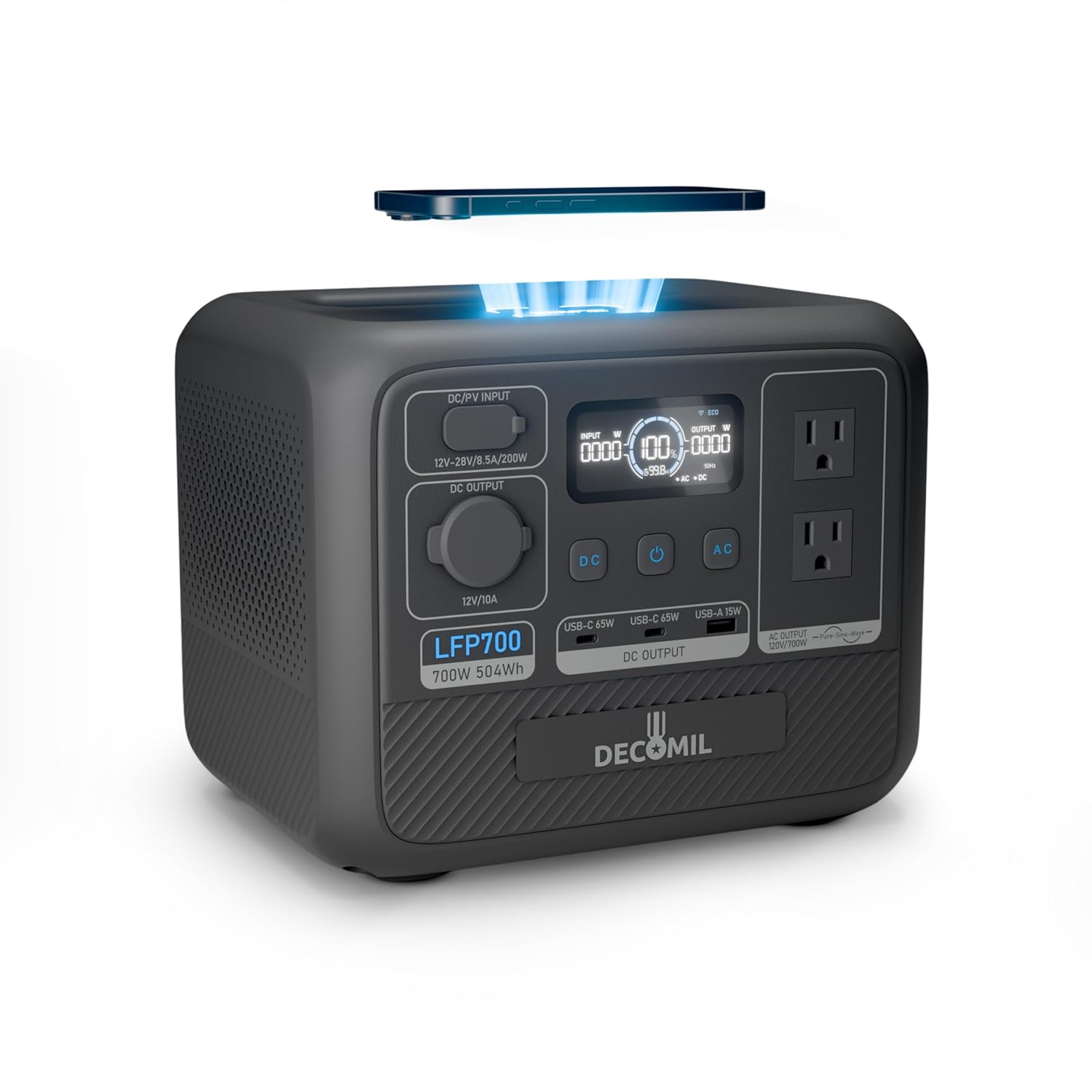
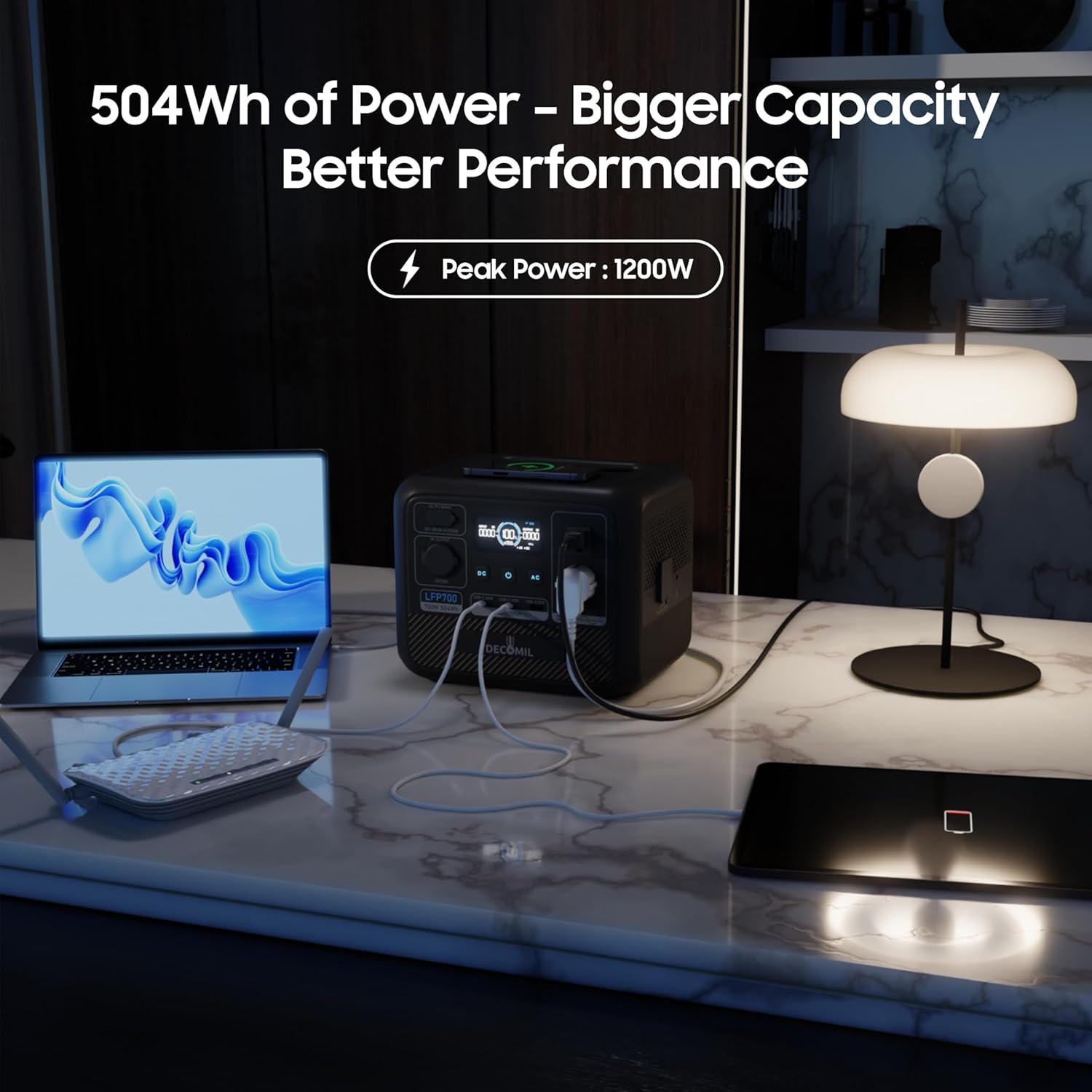
You’ll find the DECOMIL LFP700 Portable Power Station combines a compact design with robust battery chemistry and useful features for camping, emergency backup, and everyday portable power. It’s built around a 504Wh LiFePO4 battery, rated for 700W continuous AC output (1200W surge), and includes conveniences like wireless charging, a USB-C PD port, and a built-in UPS mode.
Who this unit is for
You’ll appreciate this unit if you want a lightweight, durable power station for weekend trips, short-term home backup, or as a secondary power source for work-from-anywhere setups. The LFP700 is a good fit when you need fast recharge times and many charge cycles without carrying lots of extra weight.
Key specifications
Below you’ll get the headline numbers so you can quickly compare what matters most: capacity, weight, output, and special features. These specs give a clear idea of what to expect in daily use.
| Specification | Value | Notes |
|---|---|---|
| Battery type | LiFePO4 (LFP) | High cycle life and thermal stability |
| Usable capacity | 504 Wh | Nominal energy available for loads |
| AC output (continuous) | 700 W | Suitable for many appliances |
| AC output (peak/surge) | 1200 W | Handles motor/compressor starts |
| USB-C PD | 1 × 60 W | Good for laptops and fast charging |
| USB-A | 2 × standard | Phone/tablet charging |
| DC ports | 2 × ? | For DC appliances and accessories |
| Car socket | 1 × 12V | Automotive-type devices |
| Wireless charging pad | Yes | Qi-style pad on top |
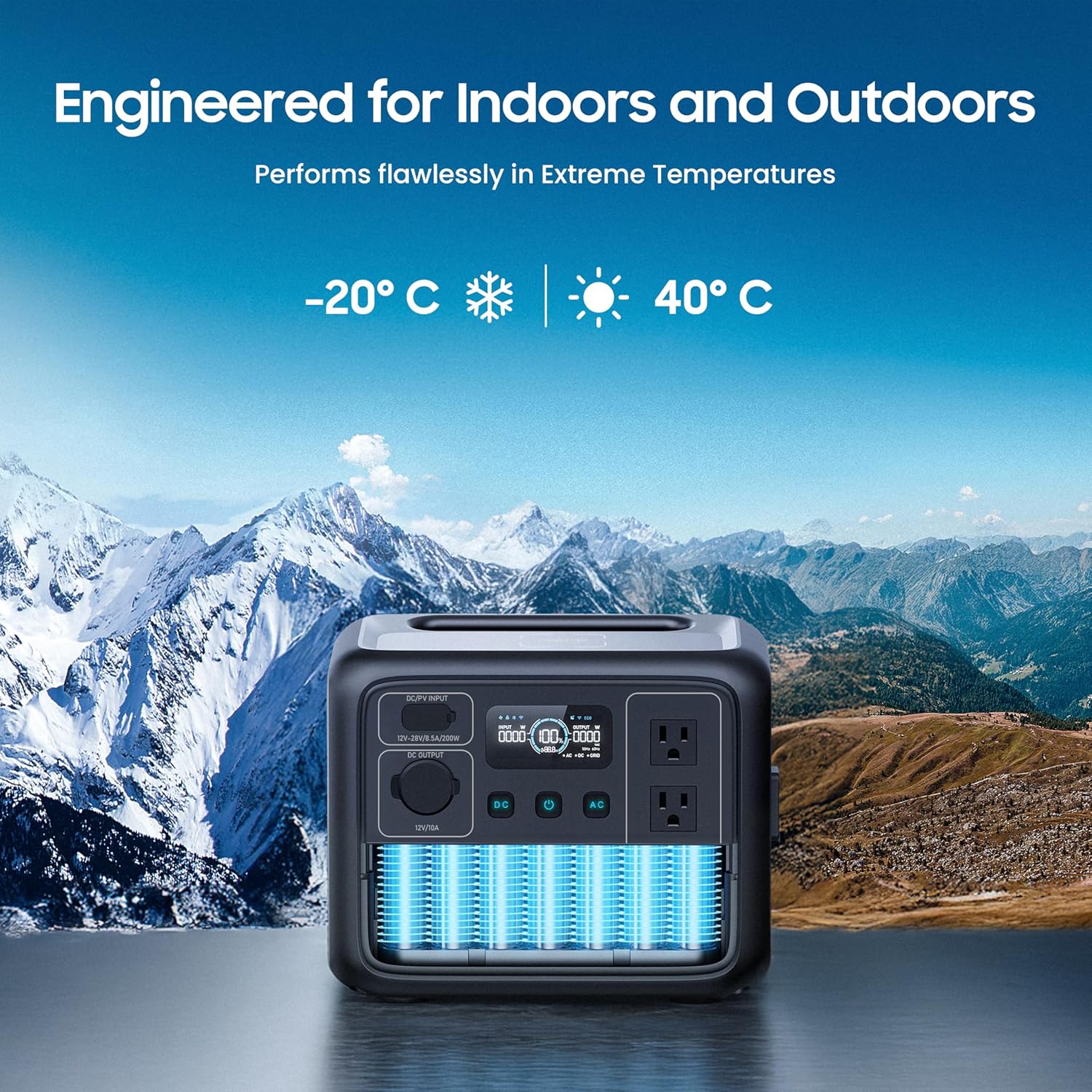
| Weight | 14.3 lbs (≈6.5 kg) | Very portable for capacity |
| Fast charge (AC) | 0–80% in 50 min | Quick top-up from wall outlet |
| Battery cycle life | 3000+ cycles to 80% | Long-lasting LiFePO4 chemistry |
| Solar compatibility | Integrated MPPT | Solar panels optional (not included) |
| Certifications | UL 2743, FCC, IC | Safety and regulatory approvals |

Design and portability
You’ll notice the LFP700 is intentionally compact and lightweight for its capacity. At 14.3 lbs, it’s easy to carry to campsites, into an RV, or around the house. The reinforced corners and solid build help it stand up to travel bumps and outdoor use.
Build quality and handling
The housing feels sturdy without being bulky, and reinforced corners reduce the chance of cosmetic damage. You’ll like the grab-friendly form factor for short hauls.
Display and controls
The informative LCD gives you battery percentage, input/output wattage, and estimated runtime. You’ll find the control layout simple and intuitive, which is great if you prefer plug-and-play operation without digging through menus.
Battery chemistry and longevity
Because the LFP700 uses LiFePO4 cells, you’ll get much higher cycle life and better thermal stability than typical lithium-ion (NMC) units. DECOMIL claims over 3000 full charge cycles before dropping to 80% capacity, which translates to many years of daily use if you choose to.
What 3000+ cycles mean for you
This lifecycle means the battery can be charged and discharged frequently with minimal long-term capacity loss. If you charge it once per day, you’re looking at multiple years—possibly a decade or more—before the battery reaches 80% of its original capacity.
Safety benefits of LiFePO4
LiFePO4 is less prone to thermal runaway and is more chemically stable. You’ll find it safer in hot climates and for repeated fast-charging sessions.
Performance and real-world runtimes
You’ll want to know what the LFP700 will actually run and for how long. Below are conservative runtime estimates using the 504Wh capacity. Actual runtimes depend on device efficiency, inverter losses, and real-world power draw.
| Device / Load | Typical Power Draw (W) | Estimated Runtime (hours) |
|---|---|---|
| Smartphone (full charge) | ~15 Wh per phone | ~30–33 full phone charges |
| Laptop (60W) | 60 W | ~7–8 hours |
| CPAP (40 W average) | 40 W | ~10–11 hours |
| Mini fridge (average) | 50–60 W | ~7–9 hours (cycles vary) |
| Portable fridge | 45 W | ~10–11 hours |
| LED lights (10 W) | 10 W | ~45–50 hours |
| 32″ TV (40–65 W) | 50 W | ~8–9 hours |
| Microwave (700 W) | 700 W | ~0.6–0.7 hours (~35–40 minutes) |
| 1200W peak devices (startup) | Surge only | Handles brief motor starts |
You’ll notice the LFP700 handles typical mobile office and small-appliance loads well. The 1200W peak makes it valuable for starting compressors and motors — for instance, fridges — while the continuous 700W rating limits you from running large heating elements or kettles.
Charging methods and times
You’ll appreciate several ways to recharge the LFP700 quickly or off-grid. Here’s what to expect for each charging method and tips to optimize charge speed.
AC wall charging (fast charge)
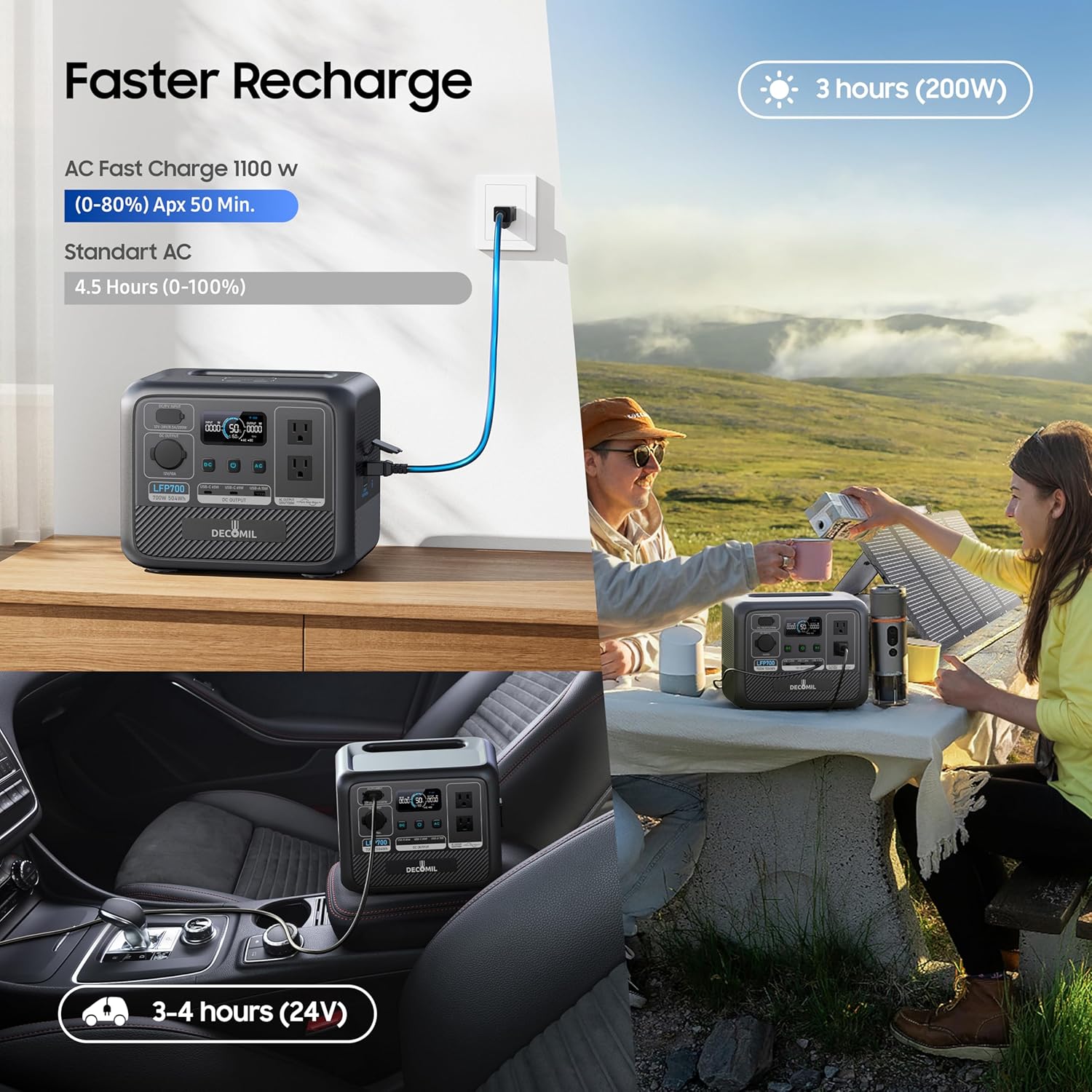
From an AC outlet, the LFP700 reaches 0–80% in roughly 50 minutes thanks to advanced fast-charging tech. You’ll find this especially useful when you need a quick top-up before leaving on a trip or during a brief power availability window.
Solar charging (MPPT)
The integrated MPPT controller gives you efficient solar charging with compatible panels (not included). You’ll want to pair it with a 100–200W panel for practical charging times:
- 100W panel: roughly 5–7 hours under ideal sunlight to approach full capacity
- 200W panels (or two 100W): roughly 2.5–4 hours under ideal sunlight
These are approximations; shading, panel angle, temperature, and cloud cover will affect real-world times. You’ll get the best results using high-quality, outdoor-rated panels and matching connectors (often MC4).
Vehicle charging and other inputs
If you plan to recharge from a vehicle, expect slower charging than AC. The LFP700 supports DC/car inputs in various designs, but check the included cable types and the maximum supported input wattage before relying on car charging as your primary method.
UPS mode and critical backup
You’ll find the built-in UPS (Uninterruptible Power Supply) feature useful for keeping critical devices online during brief outages. The UPS provides near-seamless switching so devices like routers, modems, point-of-sale gear, and some medical devices (CPAP without humidifier) stay powered without rebooting.
How UPS helps in real use
When mains power drops, the LFP700’s UPS keeps selected devices running without interruption. You’ll still need to check whether a given device draws more than the 700W continuous rating, and for devices with strict medical certification needs, verify compatibility with your provider or physician.
Ports and outputs
You’ll find a generous complement of outputs to keep phones, computers, and small appliances charged or running. The combination of USB-C PD, USB-A, DC ports, and AC outlet covers most portable power needs.
USB-C PD 60W
You’ll be able to fast-charge many laptops and tablets via the 60W USB-C PD port, and it’s efficient for running a laptop without inverting through the AC outlet.
Wireless charging pad
The built-in wireless pad gives you clutter-free phone charging. You’ll appreciate not needing cables for quick top-ups, though wired ports remain more efficient for high-power devices.
AC outlet
The single 700W rated AC outlet supports common devices like small microwaves for short bursts, laptops via chargers, TV sets, and more. You’ll want to monitor draw to avoid surpassing the continuous rating.
Noise, cooling, and environmental behavior
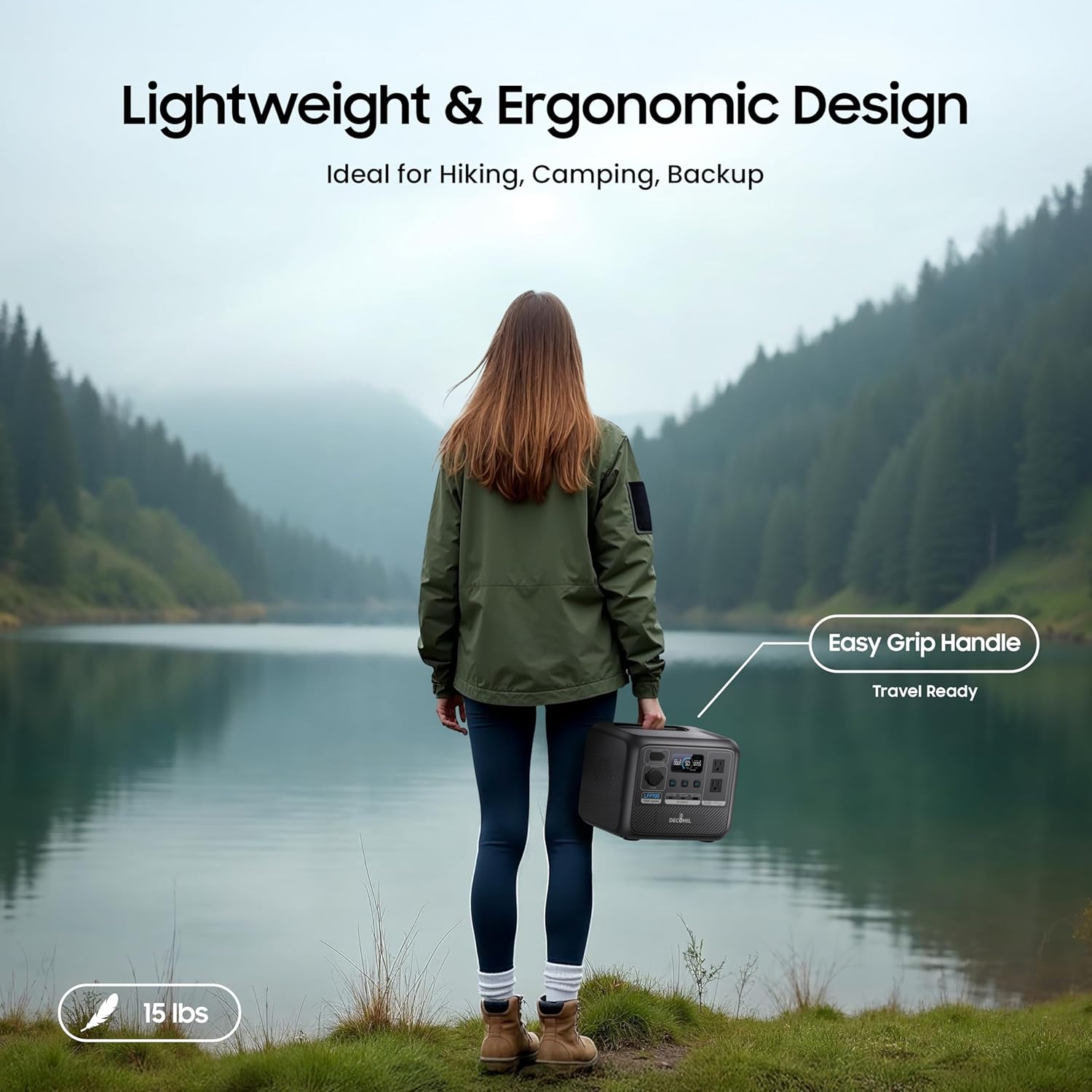
You’ll notice whisper-quiet fan cooling that keeps the unit cool without being distracting. The fan engages based on thermal and load conditions, so for low-power draws it will remain almost silent, which is ideal for sleeping or quiet campsites.
Operating temperature and storage
You’ll want to store the unit in a cool, dry place and avoid prolonged exposure to direct sun while charging. LiFePO4 is more tolerant of temperature extremes than some chemistries, but sensible storage extends lifespan.
Safety and certifications
You’ll be reassured by UL 2743, FCC, and IC compliances, which show the unit has passed safety and regulatory tests. The built-in Battery Management System (BMS) protects against overcharge, over-discharge, short circuits, and overheating.
Travel and indoor use
Because of certifications and the LFP chemistry, you’ll find this unit suitable for many indoor uses and legal for travel in many scenarios. Still, check airline rules if you plan to fly with a large battery — 504Wh typically exceeds most airline carry-on limits, so confirm with your carrier before attempting air travel with the unit.
Solar setup recommendations
You’ll get the best solar performance when pairing the LFP700 with panels and cables that match its MPPT input specs. Consider:
- Panel wattage: 100–200W panels are a practical match.
- Sun conditions: aim for clear midday sun for peak output.
- Connectors: confirm MC4 or other connectors and use rated cables.
If you plan to rely heavily on solar, configuring a multi-panel setup for morning-to-afternoon coverage will reduce downtime and give you more usable hours.
Practical use cases and scenarios
You’ll find the LFP700 convenient for a range of activities. Below are common scenarios and how this unit performs in them.
Weekend camping
You’ll easily power lights, a small fridge, phone and laptop charging, and an electric kettle of lower wattage for brief use. Pack the fast AC charging cable to top up on return to civilization.
Road trips and overlanding
You’ll appreciate the light weight and UPS features if you want to keep devices and small appliances powered between stops. Use the car socket for modest in-vehicle charging, but plan AC charging for fast recharges.
Home backup for outages
You’ll use the LFP700 to keep essential electronics alive: Wi‑Fi router, phone, small fridge, CPAP, and lights for several hours depending on load. The UPS makes transitioning smooth for critical devices.
Work-from-anywhere
You’ll be able to run a laptop for an entire workday and still have power to spare for phone charging, a small monitor, and LED lighting.
Pros and cons
You’ll find this short breakdown helps you decide if the LFP700 matches your priorities.
Pros:
- Excellent power-to-weight ratio at 14.3 lbs with 504Wh
- LiFePO4 chemistry with 3000+ cycles means long life
- Very fast AC charging: 0–80% in ~50 minutes
- 700W continuous and 1200W surge supports many appliances
- Integrated MPPT for solar compatibility
- Wireless charging and USB-C PD 60W for convenience
- Quiet fan and user-friendly LCD/interface
- Certifications: UL 2743, FCC, IC
Cons:
- Single AC outlet may be limiting if you need multiple AC devices simultaneously
- 700W continuous restricts running high-wattage heaters, kettles, or larger appliances
- Solar panels not included — extra cost for full off-grid setup
- Weight, while light for capacity, is still a limit for ultralight backpacking
Setup and first-time use
You’ll want to follow a few simple steps the first time you use the LFP700 to maximize battery health and performance.
- Charge it fully via AC before first heavy use to balance the battery.
- Familiarize yourself with the LCD and button layout.
- Test the UPS by connecting a critical device and simulating a power loss.
- If using solar, verify the panel connectors and orientation for best input.
Maintenance and storage tips
You’ll extend the life of the LFP700 by following a few common-sense practices.
- Store 40–60% charged for long-term storage and top up every few months.
- Keep it away from extreme heat or freezing temperatures.
- Clean ports and surfaces with a dry cloth; avoid liquids.
- Update firmware if DECOMIL provides updates and instructions.
Troubleshooting common issues
If you run into trouble, these steps will help you diagnose and fix common problems.
- Unit not charging: check input cables, AC outlet, and solar panel connections. Confirm the unit isn’t in a locked or standby state.
- Overload/AC trips: reduce the load to under 700W continuous; restart the unit if necessary after clearing the load.
- Pack not turning on: ensure the internal battery isn’t at a protective cut-off; try charging briefly and then powering on.
- Unexpected shutdowns: check for thermal conditions (too hot) or a depleted battery, and verify firmware or BMS warnings on the LCD.
Comparing alternatives (what you should consider)
You’ll want to compare the LFP700 to other mid-capacity power stations by weighing cycle life, charge speed, weight, and AC output. The major differentiator here is LiFePO4 with 3000+ cycles and AC fast charge to 80% in under an hour. If long lifespan and fast recharge are priorities, this unit stands out. If you need larger continuous AC wattage or multiple AC outlets, consider higher-power models or multiple units.
Accessories to consider buying
You’ll probably want a few extras to get the most out of the LFP700:
- Solar panel(s) 100–200W with MC4 connectors
- Additional AC or DC cables for specific devices
- Protective carrying case for transport
- Power strip for more AC outlets (watch combined load)
- Car charging adapter if you plan vehicle charging frequently
FAQs you’ll ask
Q: Can you run a CPAP for a whole night? A: In many cases yes—depending on your CPAP’s power draw and whether it uses a humidifier. Expect roughly 8–12 hours for many CPAP units when used conservatively.
Q: Will it power a refrigerator all day? A: For a standard household fridge, runtime depends on duty cycle and power draw. A small fridge or well-insulated 12V compressor cooler is an excellent match; a full-size fridge could run for several hours but likely not a full day without recharging.
Q: Can I take it on a plane? A: Most airlines restrict batteries over 100Wh without special approval. The 504Wh rating exceeds typical airline limits; check with your carrier for rules before attempting to transport it by air.
Q: Is the wireless pad fast? A: It’s convenient for topping up phones, but wired charging (USB-C PD) is more efficient for high-speed charging.
Final thoughts and buying guidance
You’ll get a well-rounded portable power station in the DECOMIL LFP700 if your priorities include a lightweight package, fast AC recharge, long-lasting LiFePO4 chemistry, and a useful set of outputs. It’s particularly strong for campers, weekend travelers, and anyone who wants many charge cycles without the weight penalty of older chemistries.
If you need higher continuous AC power or multiple AC outlets, consider larger systems or supplementing this unit with additional power stations. If long life, fast recharge, and solar compatibility are high on your list, the LFP700 is a smart choice that should give you years of reliable service.
If you want, I can provide a tailored estimate for how long the LFP700 will run your specific devices—tell me the devices and their wattages or model numbers and I’ll calculate realistic runtimes and charging scenarios.
Disclosure: As an Amazon Associate, I earn from qualifying purchases.