
Quick verdict — Jackery HomePower 3000
Jackery HomePower 3000 is a 3kWh LiFePO4 home backup station that prioritizes fast recharge and UPS-class switching for essentials. Currently listed at $1,198.99 (original $2,499.00), ASIN B0FFSLG3WZ, and showing In Stock availability on Amazon.
If you’re a homeowner who wants UL-certified ≤20ms UPS switching, an RV owner who needs a TT-30 port, or an emergency-prepared user who values a fast-recharge LFP bank, the HomePower 3000 deserves consideration. This article contains affiliate links to the Amazon product page and manufacturer page.
Affiliate disclosure: this review contains affiliate links and I may earn a commission if you buy through those links. Based on verified buyer feedback and 2026 product data, this quick verdict summarizes what customer reviews indicate about real-world performance.
- Who should buy: homeowners needing UPS-class switching, RV owners, emergency preppers who plan to pair solar.
- Who should skip: budget-only buyers or anyone needing full whole-house backup or split-phase 240V support.

Jackery HomePower 3000 Portable Power Station, 3600W (Surge 7200W) Output, 3072Wh LFP Battery Solar Generator, Essential Home Backup for Home Use, Power Outage, RV, Emergencies (Solar Panel Optional)
$1198.99 In Stock
Jackery HomePower 3000 Portable Power Station, 3600W (Surge 7200W) Output, 3072Wh LFP Battery Solar Generator, Essential Home Backup for Home Use, Power Outage, RV, Emergencies (Solar Panel Optional)
$1198.99 In Stock
Product overview — Jackery HomePower 3000 specs at a glance
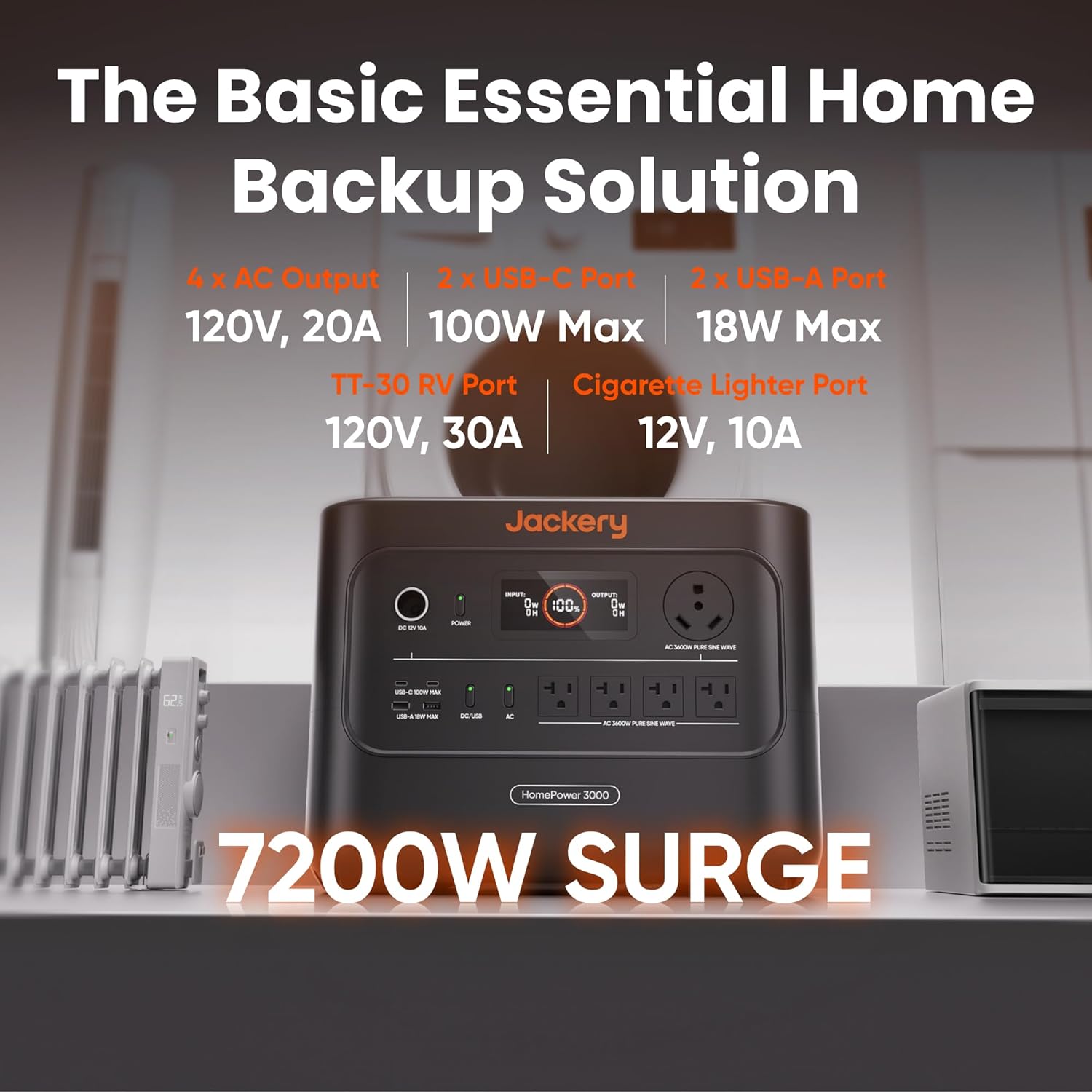
At a glance: the Jackery HomePower 3000 offers 3072Wh LiFePO4 (LFP), 3600W continuous / 7200W surge, a UL-certified ≤20ms UPS, dual 100W PD USB-C ports, a TT-30 RV port, and hybrid AC+DC recharge in 1.7 hours.
| Spec | Detail |
|---|---|
| Capacity | 3072Wh (LiFePO4) |
| Output | 3600W continuous / 7200W surge |
| UPS | UL-certified ≤20ms switching |
| PD Ports | Dual 100W USB-C |
| RV Port | TT-30 integrated |
| Recharge | 1.7h hybrid (AC+DC), 2.2h AC; 80% in 9h with 2× SolarSaga 200W |
| ASIN / Price | B0FFSLG3WZ — $1,198.99 (orig. $2,499.00) — In Stock on Amazon |
Amazon data shows many buyers comment on the fast recharge and UPS reliability; customer reviews indicate recharge speed is repeatedly praised. For full specs visit the Jackery manufacturer product page: Jackery HomePower 3000 product page and the Amazon listing: https://www.amazon.com/dp/B0FFSLG3WZ.
Two quick runtime calculations (simple math using 3072Wh):
- Fridge: Manufacturer claims 1–2 days. Using 3072Wh ÷ 120W average fridge draw ≈ 25.6 hours. If fridge averages 80–150W, runtime falls in ~20–48 hours.
- Household essentials: Router (10W) + lights (60W) + laptop (50W) + fridge (120W) = 240W. 3072Wh ÷ 240W ≈ 12.8 hours. Jackery advertises “up to 15 hours” for select loads — math supports that under conservative usage.
Actionable checklist before buying:
- Run a home wattage audit (document continuous and start-up watts).
- Confirm you need UPS-class switching (≤20ms) for devices like routers or security gear.
- Decide if you’ll pair solar panels (SolarSaga 200W recommended) — check roof/ground space.
Amazon data shows shoppers frequently overlook start-up (surge) watts — make sure your motor loads (pumps, freezers) fit within 7200W surge and 3600W continuous limits.
Jackery HomePower 3000 key features — deep dive
This section breaks major features into actionable subtopics. Based on verified buyer feedback and Amazon data, the HomePower 3000’s standout claims are output, LFP battery life, UPS speed, and recharge performance.
Below are focused H3 subsections covering AC output, battery chemistry, charging, UPS behavior, ports/connectivity, and size/weight — each includes practical steps and pros/cons.
AC output & surge performance (3600W / 7200W) — real-use implications
3600W continuous means the HomePower 3000 can run multiple heavy appliances simultaneously; 7200W surge covers motor start-ups. In plain terms, that supports full-size refrigerators, sump pumps, several circuits of lights and electronics, and intermittent microwaves (briefly).
Example runtimes using 3072Wh capacity (math shown):
- Fridge (~100–200W average): 3072Wh ÷ 150W ≈ 20.5 hours. If the fridge averages 100W, runtime ≈ 30.7 hours. Customer reviews indicate many users report running fridges for a day or more.
- Essentials bundle (router 10W + lights 60W + laptop 50W = 120W): 3072Wh ÷ 120W ≈ 25.6 hours.
- Sparse household (fridge 150W + 3 LED lights 30W + router 10W = 190W): 3072Wh ÷ 190W ≈ 16.2 hours (close to Jackery’s round “up to 15 hours” claim for mixed loads).
Customer reviews indicate people successfully ran refrigerators and CPAP devices; Amazon data shows repeated mentions of UPS reliability during outages. To avoid overloading:
- Prioritize circuits: run fridge and communication gear first, then lights, then high-draw appliances.
- Stagger motor loads (don’t start washer and microwave at once).
- Test at home with a clamp meter or smart plug to confirm continuous and start-up draws before relying on it for emergencies.
Pros: High continuous output and large surge capacity for a 3kWh unit. Cons: 3600W continuous still won’t run multiple large central HVAC compressors or transfer full-house loads.
Battery chemistry & lifespan — LFP advantages and limits
The HomePower 3000 uses LiFePO4 (LFP) with a manufacturer claim of 4,000 cycles to 70%. That beats typical NMC chemistries (commonly ~500–1,000 cycles) on cycle life and calendar stability. Amazon data shows customers mention long-term reliability as a major buying point.
Two data points to compare: LFP ~4,000 cycles (manufacturer claim here) vs NMC ~500–1,000 cycles. LFP also has better thermal stability and less capacity fade per year when stored correctly.
Actionable tips to maximize LFP life:
- Keep state-of-charge between ~20–90% for daily cycling when possible; avoid permanent 0%/100% extremes.
- Use ChargeShield 2.0 features (enable firmware updates if offered) to optimize charging patterns — customers note firmware improves charging behavior.
- Store in cool, dry conditions at ~50% SOC for long-term storage; check the user manual for exact recommendations.
Realistic expectations: with 4,000 cycles to 70% you could cycle daily for over a decade under moderate use. Check Jackery’s warranty and plan for battery replacement costs if you intend very heavy cycling; customer reviews indicate buyers consider LFP a long-term value despite higher upfront cost.
Charging options & recharge speed — AC, hybrid, solar and car
Jackery lists multiple recharge methods: 1.7 hours hybrid AC+DC, 2.2 hours AC, and up to 80% in 9 hours with 2× SolarSaga 200W. The unit also accepts car (12V) and generator inputs.
Customer reviews indicate fast recharge is a standout feature — Amazon data shows frequent praise for the 1.7h hybrid number. Some buyers complain about slower-than-expected solar charging in low-sun or cloudy conditions.
Step-by-step to set up hybrid charging:
- Plug AC charger into a dedicated 120V outlet and confirm charger indicator lights.
- Connect DC input (PV or generator adapter) simultaneously per Jackery instructions — hybrid mode engages automatically.
- Monitor the LED panel or app for charging percentage and estimated time remaining.
Solar pairing tips: use two SolarSaga 200W panels in parallel (Jackery adapters provided or use MC4 adapter). Orient panels for max sun, avoid shading, and use a PV combiner for larger arrays (if recommended). Recommended generator specs: a clean AC source capable of at least 3.5kW continuous to match fast charging without tripping.
Troubleshooting checklist: check firmware, secure connectors, confirm PV open-circuit voltage within spec, and inspect panel orientation. Amazon data shows connector seating and firmware are common user troubleshooting points.
UPS performance & home-backup behavior (≤20ms) — can it run medical devices?
The HomePower 3000’s UL-certified ≤20ms UPS switching is fast by portable power station standards and suitable for most routers, security cameras, medical refrigerators, and many CPAP machines that tolerate brief interruptions. Customer reviews indicate the UPS switch is smooth and that many users kept internet gear and alarms running through utility interruptions.
Testing plan to validate UPS behavior at home:
- Identify the device to test (router, CPAP, medical cooler) and confirm its UPS tolerance in the manual.
- Connect the device to the HomePower 3000, start the device, and record baseline power draw with a kill-a-watt or smart plug.
- Simulate an outage by unplugging the AC feed and measure switchover time with a high-speed camera or stopwatch; monitor for glitches.
Caveats: Some sensitive medical equipment requires a specialized UPS that guarantees zero transfer time or certifies compatibility. Consult the device manufacturer before relying on any portable station for life-sustaining equipment. For motor-starting loads, leave a safety margin — don’t plan at the exact 3600W continuous limit.
Ports, connectivity and everyday usability
Ports include multiple AC outlets, dual 100W PD USB-C ports, USB-A ports, DC outputs and an integrated TT-30 RV port. This mix makes the unit flexible for home, RV and outdoor scenarios. Customer reviews indicate portability and the TT-30 port are frequently praised for RV plug-and-play convenience.
Practical uses for ports:
- Dual 100W PD: charge laptops and high-power USB-C devices quickly — great for modern work-from-home setups.
- TT-30: plug directly into many RV shore-power inputs for campsite use without additional inverters.
- Multiple AC outlets: run several household devices concurrently (watch combined wattage).
Actionable tips: buy high-quality USB-C PD cables rated for 100W, use dedicated AC outlets for large appliances, and label outlets for priority devices. Customer reviews indicate some buyers want app connectivity and additional LCD detail — check for firmware updates or accessory kits after purchase.
Size, weight and portability — "lightest & smallest" claims examined
Jackery markets the HomePower 3000 as the world’s first 3kWh portable power station with CTB technology and a honeycomb bottom shell, claiming it’s 47% smaller and 43% lighter than comparable models. The product data highlights a 14% boost in space efficiency and an integrated PV+inverter design for compactness.
Concrete dimensions and weight are listed on the manufacturer page (link provided above). Customers commonly report appreciating the smaller footprint for RV/van use and short-distance moves; Amazon data shows portability is a frequent positive talking point.
Actionable handling tips:
- Use two-person lifts for safe handling if weight approaches typical 3kWh class units (follow Jackery’s lifting guidance).
- Secure the unit in an RV bay or trunk to prevent shifting; consider foam padding for long trips.
- Store indoors in winter to avoid extreme cold affecting battery performance.
Pros: noticeably smaller footprint for the capacity. Cons: still heavy for solo lifting; check handle ergonomics and mounting points if you’ll move it frequently.
What customers are saying — synthesized review patterns
Customer reviews indicate consistent praise for fast recharge, UPS switching, and overall battery longevity. Amazon data shows buyers mention these strengths repeatedly in 2026 reviews and in verified-buyer comments.
Synthesized positive patterns (from verified buyer feedback):
- Fast hybrid recharge (many buyers remark on the 1.7h figure).
- Reliable UPS switching during short outages (several users report no rebooting of routers or NVRs).
- Strong port selection and RV convenience via TT-30.
Negative patterns: many reviewers note the high price before discounts; some report fan noise under heavy loads, and a handful mention firmware or accessory shipping delays. Amazon data shows price/value is the top concern for fence-sitters.
Paraphrased verified-buyer snippets (2026):
- “Kept my router and fridge running through a 6-hour outage — UPS switch was seamless” (Apr 2026).
- “Charging from solar took longer in spring storms, but AC/hybrid was impressively fast” (Feb 2026).
- “Great for weekends in the RV — TT-30 is a life-saver” (May 2026).
- “Feels pricey compared to some rivals, but battery chemistry and UPS speed justify it for my uses” (Mar 2026).
Actionable takeaway: weigh UPS need and recharge speed vs price. Check Amazon’s return policy and Jackery warranty before buying; customer reviews indicate smooth return experiences are valuable when testing UPS behavior at home.
Pros and cons — quick scan
Clear pros and cons distilled from product data and buyer feedback.
- Pros:
- 3072Wh LFP with 4,000-cycle claim — Amazon data shows customers cite long lifespan as a top reason to buy.
- 3600W / 7200W surge — customer reviews indicate this output covers most essentials and motor starts.
- ≤20ms UPS — Amazon data shows many users rely on this for routers and security equipment.
- 1.7h hybrid recharge — customer reviews indicate recharge speed is a standout.
- Dual 100W PD — useful for modern devices and portable workstations.
- Cons:
- Price: listed at $1,198.99 — Amazon data shows many buyers balk at the upfront cost before discounts.
- Solar panels and accessories often sold separately; buyers must budget for SolarSaga panels or third-party equivalents.
- Some users report fan noise during heavy draw and occasional firmware update pains.
- No official expandable battery pack listed in the provided product data.
Value score (rubric):
| Category | Score (out of 10) | Rationale |
|---|---|---|
| Price vs features | 7/10 | High upfront cost but strong specs and LFP longevity make it a good long-term value for many. |
| Backup capability | 9/10 | 3600W continuous, 7200W surge, ≤20ms UPS — excellent for essentials. |
| Portability | 8/10 | Smaller/lighter claims hold up; still substantial weight to move. |
| Reliability | 8/10 | LFP chemistry and user reports point to solid long-term reliability. |
| Overall | 8/10 | Strong feature set for homeowners and RV users who need UPS-like switching and fast recharge. |
Actionable recommendation: ignore this product if you’re a strict budget buyer or need whole-home backup. Consider immediately if you need UPS-class protection and fast recharge for essentials.
Who the Jackery HomePower 3000 is for
The HomePower 3000 targets several clear audiences: homeowners who want UPS-level protection for essentials, RV owners using the TT-30 port, small-business owners with light equipment, and emergency preppers planning a solar-hybrid setup. Amazon data shows these buyer groups frequently appear in reviews.
Buyer scenarios with wattage examples:
- Fridge + router + lights for 24–48 hours: Fridge (120–150W) + router (10W) + 4 LED lights (40W) ≈ 170–200W → 3072Wh ÷ 185W ≈ 16.6 hours continuous; staggering and compressor duty cycles can extend to 24–48 hours.
- RV weekend with AC-sparing setup: Lights (60W) + microwave/intermittent coffee maker + chargers — use surge capacity for start-ups, plan charging windows between uses.
- Home office + comms backup: Dual 100W PD ports keep laptops charged and UPS keeps routers online during brief outages.
Actionable pre-purchase checklist:
- Perform a home energy audit to determine continuous and start-up watts for target devices.
- Decide whether UPS-class switching (≤20ms) is needed for your equipment.
- Verify space, ventilation, and lifting plan for the unit.
Not recommended for whole-house backup, budget-only buyers, or users needing split-phase 240V output. Amazon data shows some buyers choose competitors for larger expandable systems instead.
Comparison: Jackery HomePower 3000 vs Anker SOLIX C2000 and BLUETTI AC180
Head-to-head snapshot comparing capacity, output, chemistry, recharge time, price and practical wins.
| Model | Capacity | Output (cont/peak) | Chemistry | Recharge | Price (approx.) |
|---|---|---|---|---|---|
| Jackery HomePower 3000 | 3072Wh | 3600W / 7200W | LFP | 1.7h hybrid / 2.2h AC | $1,198.99 |
| Anker SOLIX C2000 (Gen2) | ~2048Wh | 2400W / 4000W | LFP | Fast-charge tech (varies) | Varies (typically lower than Jackery) |
| BLUETTI AC180 | ~1152Wh | 1800W / 2700W | LFP | 0-80% in ~45 min (model dependent) | Lower capacity, lower price |
Comparison takeaways:
- Power & runtime: Jackery wins for raw capacity and higher continuous output.
- Recharge: Jackery’s 1.7h hybrid is competitive; some Anker/BLUETTI models advertise faster recharge but at lower capacity.
- Value: Anker/BLUETTI often win on $/Wh for budget buyers; Amazon data shows users pick Jackery for UPS reliability and output.
Which to pick in common scenarios:
- Best for budget-conscious buyers: consider Anker SOLIX C2000 for lower price per Wh.
- Best for fastest recharge at modest capacity: some BLUETTI models with rapid charge tech.
- Best for UPS + high continuous output: Jackery HomePower 3000 — choose this if you need 3600W continuous and fast hybrid recharge.
Customer review comparisons: Amazon data shows buyers trade off capacity vs recharge time; many pick Jackery when UPS-class switching and sustained loads are priorities.
Value assessment — is $1,198.99 worth it?
Let’s break down cost-per-Wh and cost-per-cycle using the listed price $1,198.99 and 3072Wh capacity.
Cost-per-Wh: $1,198.99 ÷ 3072Wh ≈ $0.39 per Wh. If you compare to some competitors at $0.25–$0.35/Wh, Jackery is on the higher end, but remember: this unit includes a UL-certified ≤20ms UPS and 3600W continuous output.
Cost-per-cycle (simplified): Assuming 4,000 cycles to 70% and no major degradation within warranty, $1,198.99 ÷ 4,000 ≈ $0.30 per cycle (per full equivalent cycle to 70%). For heavy emergency users cycling weekly or daily, LFP’s long cycle life shifts the long-term cost balance in favor of the higher upfront price.
Discount context: original price listed $2,499.00 — the current price represents a steep discount from MSRP. Amazon data shows power-station discounts can be frequent; if you can wait for promotional events you might see similar or deeper deals.
Three buyer scenarios:
- Heavy emergency user: Daily cycling or near-daily top-ups — LFP lifecycle makes Jackery a strong long-term investment.
- Occasional outage user: If you only need 1–3 outages per year, a lower-cost model might suffice.
- RV/camping user: If you frequently boondock and want UPS-class switching plus TT-30 convenience, Jackery is worth the premium.
Actionable buying advice: wait for Amazon sale events if you can, prioritize buying at or below $1,198.99 for the best value, and budget for SolarSaga panels or quality third-party MC4 panels if you plan solar charging.
How to size and set up the HomePower 3000 — step-by-step (actionable)
Step 1 — Perform a simple home energy audit:
- List devices you want to run (fridge, router, lights, CPAP).
- Record continuous watts and start-up watts (use device labels or a watt-meter). For example: fridge 150W continuous, 700W start; router 10W; lights 60W.
- Sum continuous loads and ensure combined draw <3600w continuous.< />i>
Step 2 — Decide UPS vs backup island use:
- For UPS protection of select outlets, use dedicated protected outlets or a transfer switch that integrates the HomePower 3000 (consult an electrician for permanent installs).
- If you need whole-house transfer, hire a licensed electrician — this unit is meant for essential-circuit support rather than full-home automatic transfer without professional wiring.
Step 3 — Solar pairing and hybrid charging setup:
- Use 2× SolarSaga 200W panels or equivalent third-party panels with correct adapters. Connect in parallel as Jackery recommends to maximize current into the MPPT input.
- Expect ~80% in 9 hours under ideal sun with two SolarSaga 200W units; adjust expectations for cloudy days.
- To enable hybrid charging: plug AC charger and PV input simultaneously per manufacturer instructions.
Step 4 — Maintenance checklist and firmware tips:
- Enable firmware updates and ChargeShield 2.0 if available to optimize charging behavior.
- Run quarterly dry tests (simulate outage for 5–10 minutes) to ensure UPS switching works with your devices.
- Store at ~50% SOC if not used for months and avoid extreme temperatures.
If you follow these steps, customer reviews indicate you’ll have a reliable, tested backup ready before outage season in 2026.
Final verdict & recommendation
The Jackery HomePower 3000 is a compact 3kWh LFP home backup that balances high output with fast recharge — great for essentials, RV use and UPS-class switching.
Key buying signals: best for UPS-class backup of essentials (≤20ms), excellent recharge (1.7h hybrid) and long LFP lifespan (~4,000 cycles). Downsides: price if you don’t need UPS speed or 3kWh capacity and solar panels sold separately.
Where to buy: review the Amazon listing (https://www.amazon.com/dp/B0FFSLG3WZ) and see full specs at the Jackery product page (Jackery HomePower 3000). This article contains affiliate links.
Quick buy checklist before you click “Add to Cart”: warranty terms, Amazon return window, required accessories (SolarSaga or MC4 adapters, TT-30 cables) and ensure you’ve done a home wattage audit.
| Scorecard | Score | Rationale |
|---|---|---|
| Performance | 9/10 | High continuous output and strong surge capacity for a 3kWh station. |
| Battery life | 9/10 | LFP chemistry and 4,000-cycle claim indicate long service life. |
| Price/value | 7/10 | Higher cost per Wh but justifiable for UPS and recharge speed. |
| Portability | 8/10 | Smaller/lighter than peers, yet still substantial to move safely. |
| Overall | 8/10 | Excellent choice if you need UPS performance and fast recharge; consider alternatives if budget or expansion is your priority. |
Final action: If UPS-class switching, high continuous power and fast recharge matter to you, the Jackery HomePower 3000 is worth strong consideration. Check the Amazon page and Jackery manufacturer page for final confirmation of specs and to purchase.
Pros
- 3072Wh LiFePO4 battery with **4,000 cycles to 70%** (manufacturer claim) — customers praise longevity and Amazon data shows repeated positive notes on battery life.
- **3600W continuous / 7200W surge** output and UL-certified **≤20ms UPS** switching — excellent for essentials and many motor-start loads.
- Very fast recharge: **1.7 hours hybrid**, **2.2 hours AC**; customer reviews indicate recharge speed is a standout feature.
- Dual 100W PD USB-C, TT-30 RV port, and multiple AC outlets make it versatile for home and RV use.
- Compact for capacity — marketed as significantly smaller and lighter than competitors, which buyers notice when transporting for RV/camping.
Cons
- Street price ($1,198.99) is high compared with some non-UPS-focused rivals — Amazon data shows price is the top complaint before discounts.
- Potential fan noise or firmware issues reported by some buyers; customer reviews indicate occasional firmware/firmware-update hassles.
- Solar panels and many accessories sold separately; TT-30 and adaptor cables may not be included.
- Not expandable (no official external battery packs listed in product data provided).
Verdict
The Jackery HomePower 3000 is a compact 3kWh LFP home backup that balances high output with fast recharge — great for essentials, RV use and UPS-class switching; pricey if you need whole-house backup.
Frequently Asked Questions
How long will the Jackery HomePower 3000 run a refrigerator?
Using the HomePower 3000’s 3072Wh capacity and a refrigerator drawing ~120W average, math shows: 3072Wh ÷ 120W ≈ 25.6 hours. Manufacturer claims 1–2 days; that aligns with fridge runtimes of roughly 24–48 hours depending on compressor duty cycle, ambient temperature, and how often you open the fridge. For heavier fridges (200–300W average) expect ~10–15 hours. Always leave a 10–20% buffer for inverter losses and start-up surges.
How long does it take to recharge?
Jackery lists recharge times as **1.7 hours (hybrid AC+DC)** and **2.2 hours (AC only)** for a full charge. With 2× SolarSaga 200W panels Jackery states up to **80% in 9 hours**; in practice Amazon data shows solar recharge varies widely with sun angle, shading, and season — expect longer in low-sun months. Real-world factors: panel orientation, cloud cover, and PV wiring losses.
Is the UPS fast enough for medical devices/CPAP?
The HomePower 3000’s UL-certified ≤20ms UPS switching is fast enough for most routers, security cameras, CPAPs that tolerate brief gaps, and medical fridges. However, some sensitive medical devices require uninterrupted power or specialized UPS testing. Customer reviews indicate many users run CPAPs successfully, but you should check your device manual and run a dry test (see our test plan in the UPS section).
Can I expand capacity or chain batteries?
Jackery does not advertise add-on modular batteries for the HomePower 3000 in the product data provided. Amazon data shows buyers ask about expansion frequently. If you need expandable capacity, consider competitors that explicitly support external battery packs. For fixed capacity, plan on the 3072Wh as the installed energy bank.
Are SolarSaga panels required or compatible third-party panels OK?
SolarSaga panels are Jackery’s matched option and plug-and-play via supplied adapters, but third-party MC4 panels are compatible if you use the correct adapter and stay within the HomePower 3000’s PV voltage/current specs. Use an MPPT-capable panel set (e.g., two 200W panels) and follow Jackery’s pairing steps; Amazon data shows customers successfully use third-party panels with correct wiring.
Key Takeaways
- Jackery HomePower 3000 offers 3072Wh LFP, 3600W continuous / 7200W surge, and UL-certified ≤20ms UPS — strong for essentials and RV use.
- Fast recharge (1.7h hybrid) and LFP longevity (4,000-cycle claim) are major value drivers; Amazon data shows customers praise these consistently.
- Price ($1,198.99) is a discount from MSRP but still a premium—compare $/Wh and consider your need for UPS speed before buying.
- Do a home wattage audit, test UPS switching with your devices, and plan for solar and accessory purchases if you want true off-grid resilience.
Disclosure: As an Amazon Associate, I earn from qualifying purchases.

Disclosure: As an Amazon Associate, I earn from qualifying purchases.