
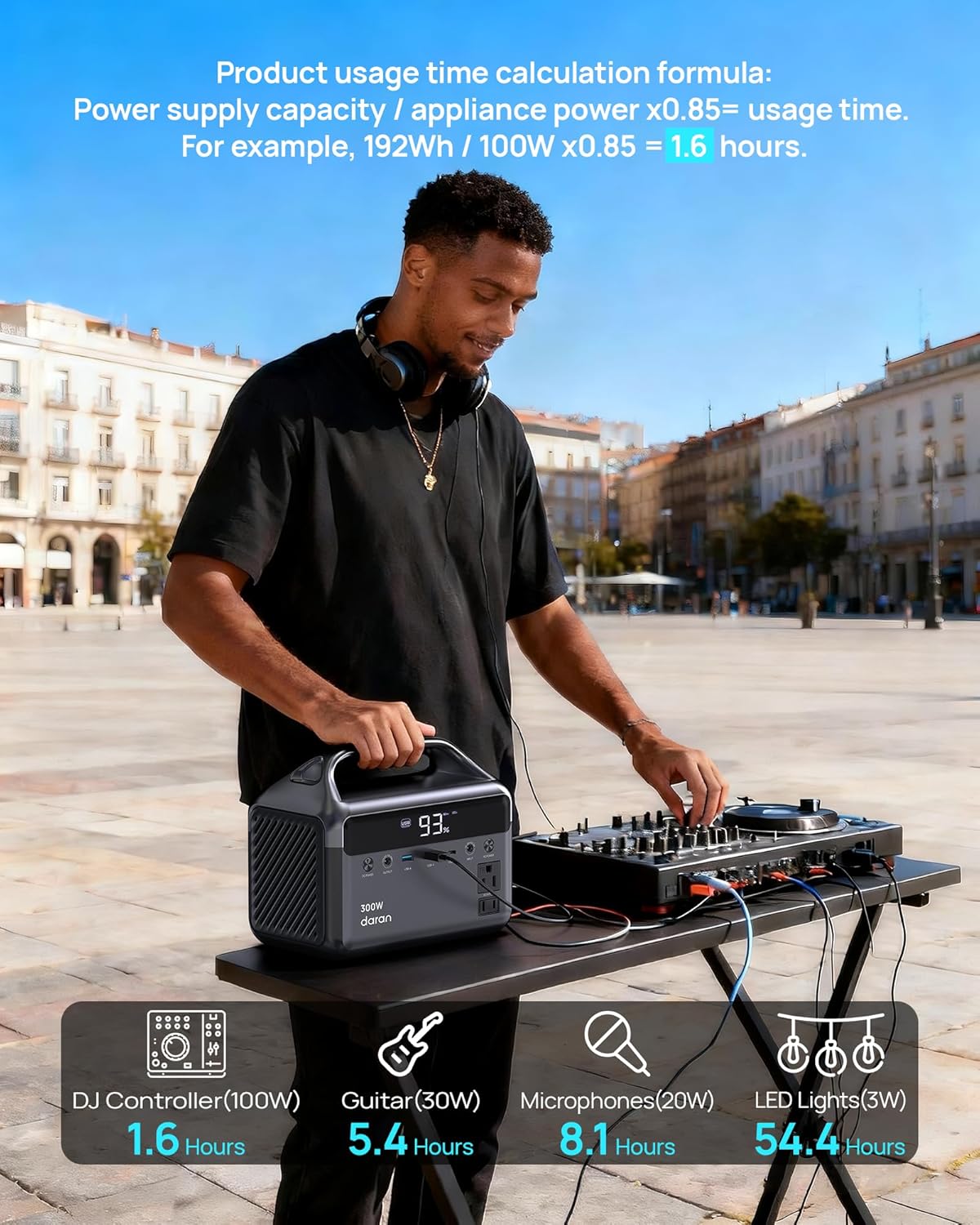
Have you ever needed reliable, silent backup power for camping, a CPAP, or holiday lights and wondered if a compact unit could actually handle the job?

Quick verdict
You get a compact, well-balanced portable power station that prioritizes safety, portability, and practical everyday use. It’s ideal for light-to-moderate loads like phones, laptops, cameras, lights, and some small appliances. If you want something lightweight with long cycle life and multiple ports, this product is a strong contender — but don’t expect it to run heavy appliances like full-size coffee makers or high-wattage space heaters.
Product overview
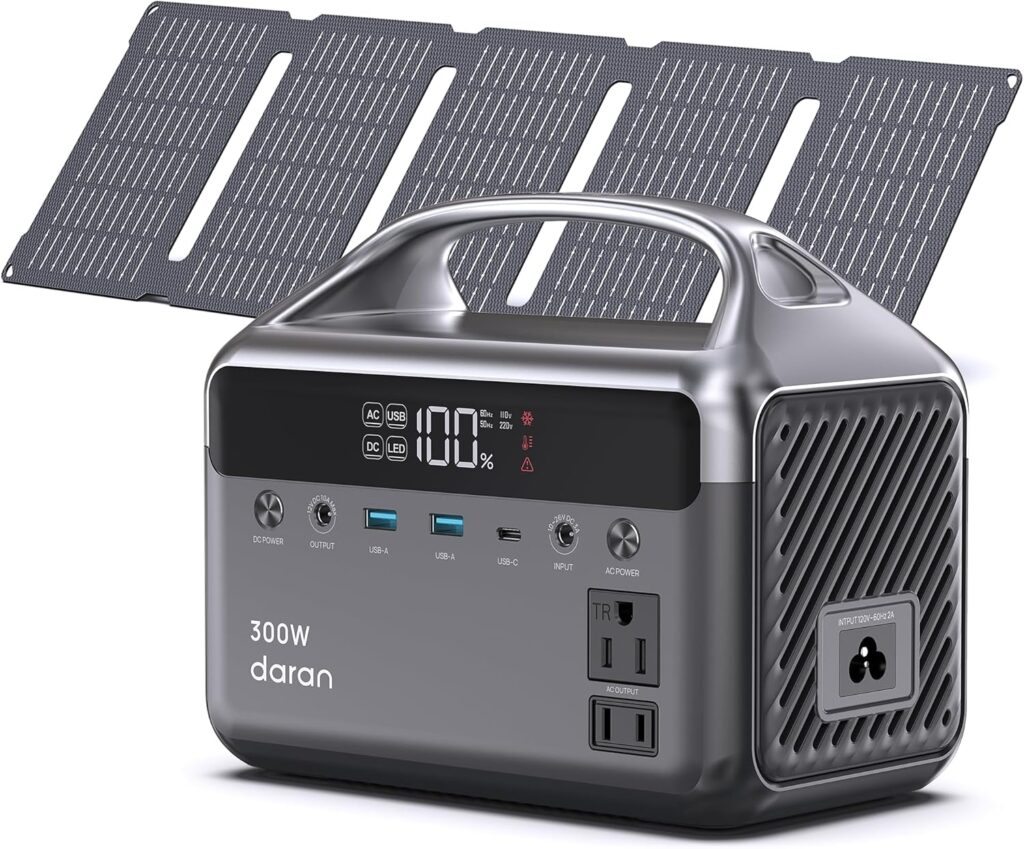
The Portable Power Station 300W, 192Wh LiFePO4 Battery Solar Generator with 40W Solar Panel & 2 AC Outlets 110V/600W Surge, Power Bank Fast Charging AC DC USB Ports for Christmas lights, Camping, RVs combines a 192Wh LiFePO4 battery with a 300W continuous AC output and a 600W surge. It comes with a foldable 40W solar panel and offers a variety of ports so you can charge multiple devices at once. The design emphasizes safety, low weight, and a long battery cycle life.

Key specifications (at a glance)
Below is a compact specification table so you can quickly see what this unit offers.
| Specification | Detail |
|---|---|
| Battery type | LiFePO4 (lithium iron phosphate) |
| Battery capacity | 192Wh (claimed 60,000mAh equivalent) |
| Rated AC output | 300W continuous |
| Surge output | 600W peak |
| AC outlets | 2 × 110V AC |
| DC outputs | 1 × DC5521 (120W) |
| USB-C | 1 × 45W |
| USB-A | 2 × 18W each |
| Solar panel (included) | 40W foldable panel (approx. 2.1 lb) |
| Weight (station) | ~5.5 lb |
| Battery cycle life | 3,500+ cycles (LiFePO4) |
| Typical AC charge to 80% | ~3 hours (AC input) |
| Solar effective input | ~28–32W (40W nominal, due to conversion) |
| Typical solar full charge | >6 hours (best conditions) |
| Use cases | Camping, RV, holiday lights, CPAP, phones, laptops, cameras |
Battery and chemistry
This unit uses a LiFePO4 battery chemistry, which is one of the safest and longest-lived lithium chemistries available. You’ll benefit from a higher cycle life than typical lithium-ion packs, meaning the battery retains usable capacity for thousands of cycles. That translates into years of regular use without significant capacity loss.
LiFePO4 also runs cooler and resists thermal runaway better than other lithium types, so it’s a safer choice for indoor and enclosed uses such as powering a CPAP overnight.
Capacity and what “192Wh” means for you
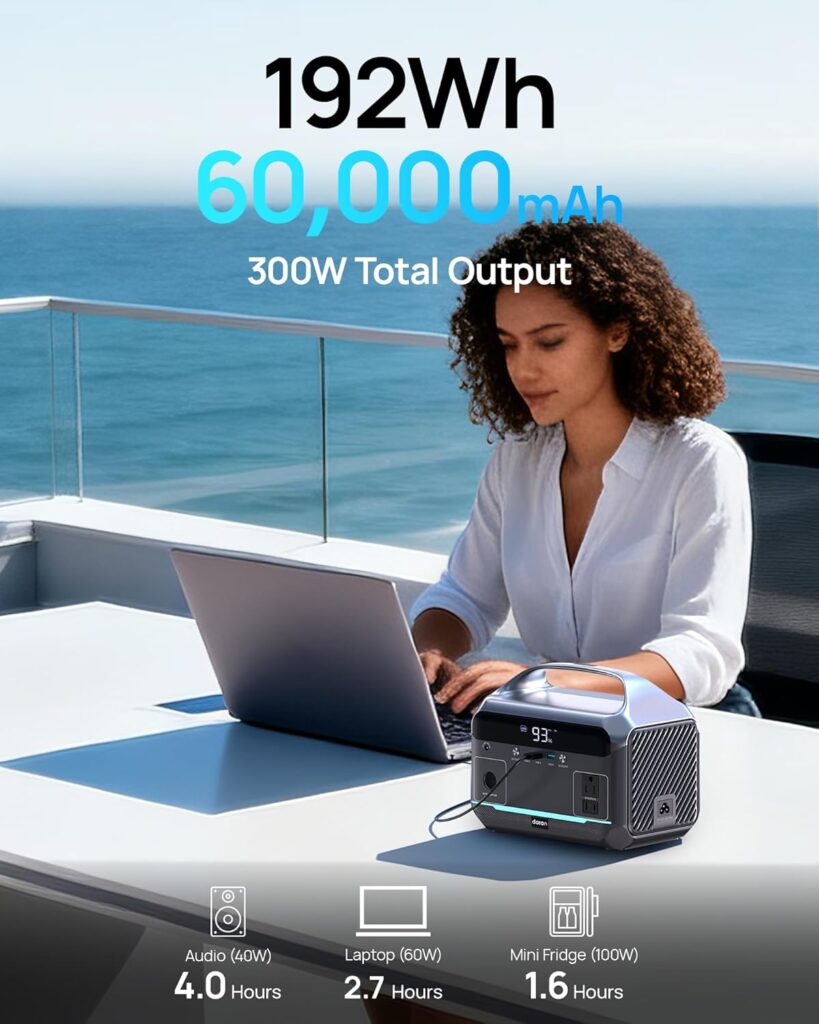
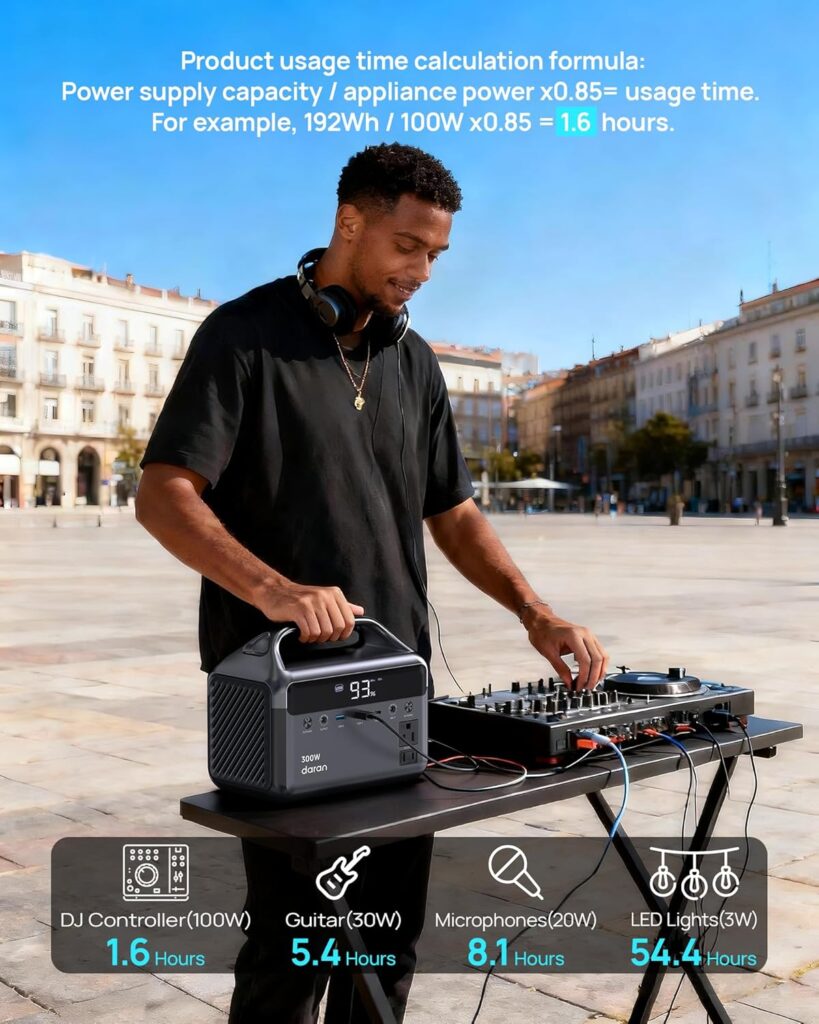
192Wh tells you the total energy stored: multiply device wattage by hours to estimate runtime. Because of inverter and conversion losses, assume about 85% usable energy. So effective usable energy ≈ 192Wh × 0.85 = ~163.2Wh. This is the energy you’ll actually get to power your devices.
Ports and output options
You get a useful spread of ports that covers most everyday needs: two AC outlets for small appliances and chargers, a DC5521 port rated for 120W, one USB-C port with 45W fast charging, and two USB-A ports at 18W each. This lets you charge phones, laptops, lights, cameras, and some small kitchen gadgets simultaneously.
The USB-C 45W port is especially handy for modern laptops and tablets that support PD fast charging. The DC5521 port is a nice inclusion for devices that still use barrel connectors or for running small DC devices directly.
What the surge rating means for you
The 600W surge rating allows short bursts of higher power at startup for devices with motors or compressors (like a small fridge) that draw more current briefly. That said, continuous draw must remain under 300W. Don’t assume surge will let you run high-wattage appliances continuously.
Charging options and charge times
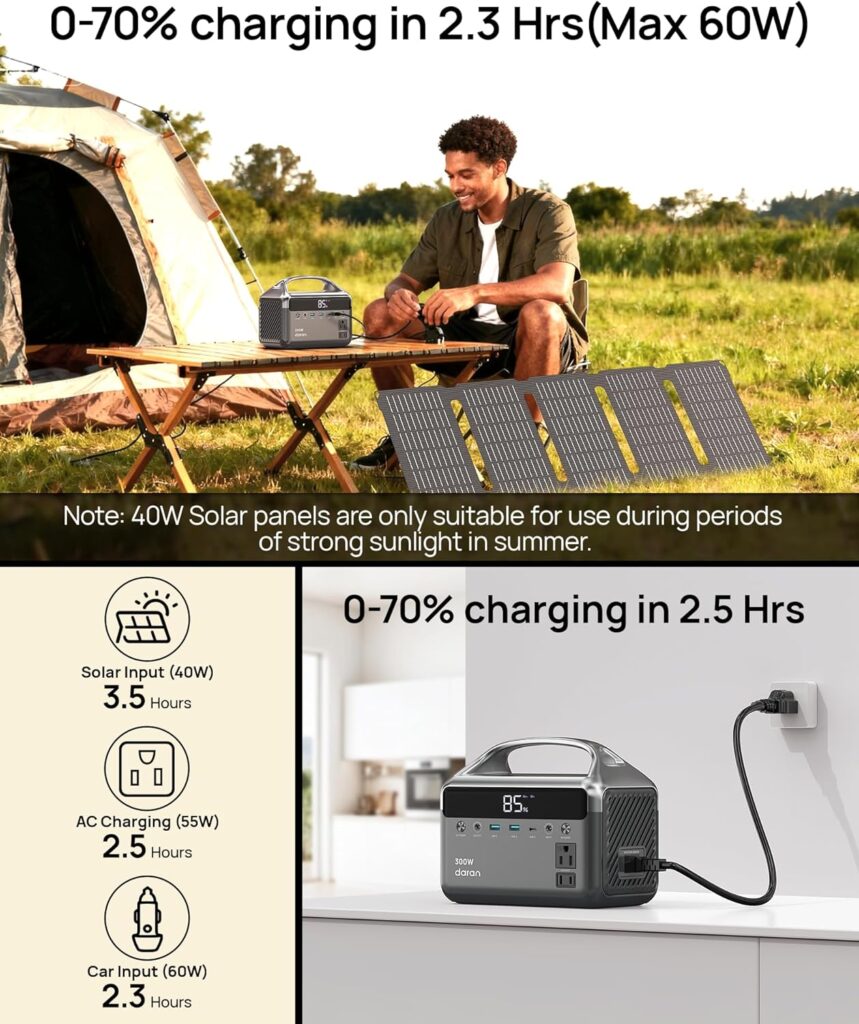
You have multiple ways to recharge the unit: AC wall charging, the included 40W solar panel, and vehicle charging. AC charging is the fastest option, and the manufacturer states you can reach about 80% in roughly 3 hours via AC. That’s a good performance for a 192Wh unit.
Solar charging with the included 40W panel works for emergencies and topping up, but it’s slow for regular full recharges. Expect effective solar input of around 28–32W due to conversion and temperature losses. That leads to more than 6 hours to fully recharge from empty under optimal sunlight, and around 5 hours to reach 80% in strong conditions. If you intend to solar-charge regularly, an 80–100W panel is recommended for practical recharge times.
Vehicle charging
Vehicle charging is supported, which provides flexibility on long road trips and in RV settings. Note that the vehicle charging cable isn’t included, so you’ll need to purchase or use a compatible cable.
Solar panel specifics (included 40W)
The foldable 40W solar panel is lightweight and portable, weighing about 2.1 lb. It’s designed for emergency or occasional top-up charging while you’re outdoors. Because of the small nominal wattage, real-world charging power is lower than 40W, and weather, angle, and temperature will further reduce output.
If you plan to rely primarily on solar charging for daily use, the 40W panel will be frustratingly slow. For regular solar-powered setups, consider upgrading to an 80–100W panel to make recharge times reasonable.
Real-world runtime examples
Below are realistic runtime estimates using the 85% usable-energy assumption (usable ≈ 163.2Wh). These show how long you can expect typical devices to run on one full charge.
| Device | Typical power draw (W) | Estimated runtime (hours) |
|---|---|---|
| Smartphone (charging) | 5–10W | 16–32 hours (multiple charges; ~10+ full charges typical) |
| Tablet | 10–15W | 10–16 hours |
| Laptop (light use) | 30–45W | 3.6–5.4 hours |
| USB-C fast-charging laptop (45W) | 45W | ~3.6 hours |
| LED camping lights (10W) | 10W | ~16 hours |
| Portable fan | 10–30W | 5.4–16 hours |
| 30W CPAP | 30W | ~5.4 hours (manufacturer example: 192Wh × 0.85 / 30W) |
| 60W mini fridge (continuous) | 60W | ~2.7 hours; compressor duty cycle may extend runtime |
| 150W stew pot | 150W | ~1.08 hours (mentioned example) |
| 300W continuous device | 300W | ~0.54 hours (not recommended for continuous high use) |
Note: These are estimates. Actual runtimes will vary with device efficiency, inverter losses, temperature, and usage patterns. Also remember surge capacity allows short starts for motors, but continuous limits still apply.
Portability and build quality
At about 5.5 lb for the power station and 2.1 lb for the panel, this system is easy to carry for a day hike, car camping, or short RV trips. The foldable panel stows compactly and the station’s form factor makes it easy to slip into a backpack or car trunk.
The case feels durable for its size and the unit runs silently with no fumes, which is a big advantage compared to gas generators. You can use it indoors safely, provided you respect ventilation and manufacturer instructions.
Safety features and battery longevity
LiFePO4 chemistry gives you inherent safety advantages: better thermal stability, lower fire risk, and robust cycle life. The claimed 3,500+ charge cycles means you can expect many years of service even with frequent use — for many users that can be 5–10+ years depending on cycle frequency and depth of discharge.
Built-in protections typically include overcharge, over-discharge, short-circuit, and temperature protections. These protect the battery, your devices, and reduce the chance of damage during abuse or abnormal conditions.
Maintenance tips for longevity
You’ll get the best life by storing the unit partially charged (around 40–60%) for long-term storage, avoiding extreme temperatures during use and storage, and charging periodically if it sits unused. Occasional full discharge cycles aren’t necessary with LiFePO4 chemistry, and frequent shallow cycles are better for lifespan.
What it can and can’t power
This is a capable small power station, but it has clear limits.
You can comfortably run:
- Phones, tablets, cameras, and small electronics
- Laptops (especially via the 45W USB-C)
- LED lights, fans, and small fridges (check continuous draw)
- CPAP machines (lower-wattage models) for several hours
- Small kitchen appliances below 300W continuous
Avoid or be cautious with:
- Coffee makers, microwaves, hair dryers, space heaters, and other high-wattage devices that require continuous power above 300W
- Heavy appliances with long run-times even if surge allows startup
Startup loads vs continuous loads
Startup (surge) capacity of 600W helps brief startup surges for motors or compressors, but continuous draw must not exceed 300W. So a small fridge that draws 100W continuously with 300W startup is okay; a 1,500W heater is not.
Use cases and scenarios
This unit fits a variety of real-life situations. Below are common scenarios and what you can expect.
Camping and overnight trips
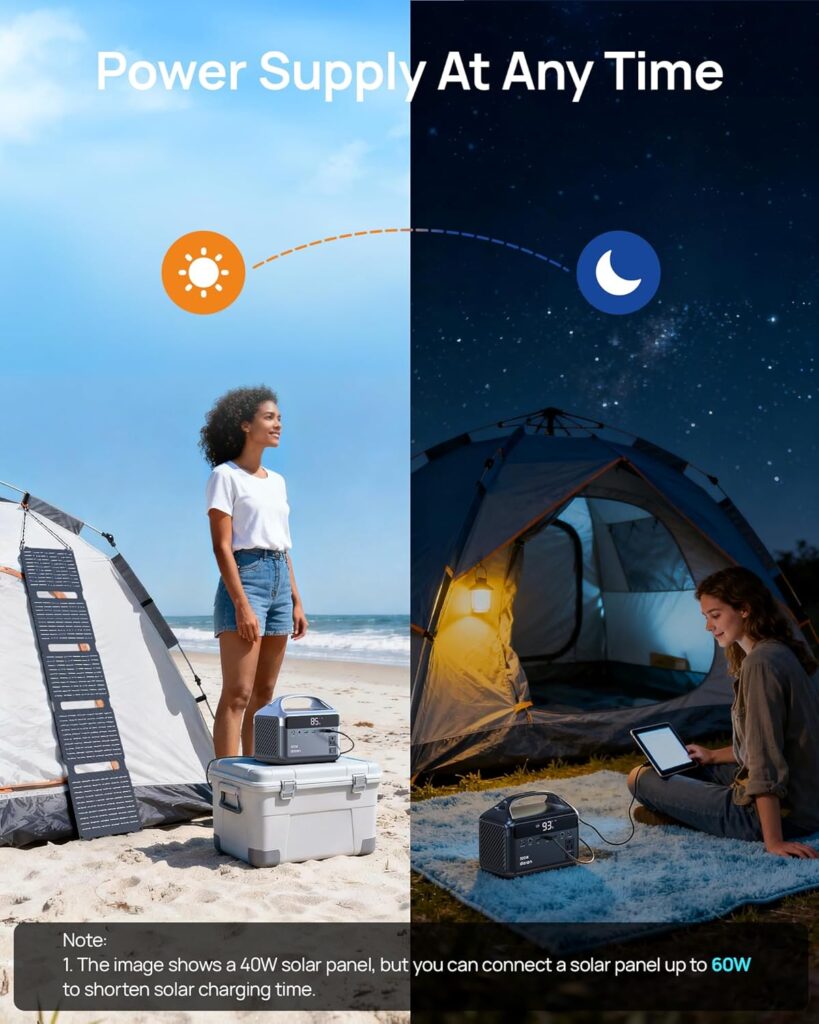
You can keep a phone and tablet charged, run LED lights, power a speaker, and top up a laptop. The station is light enough to carry a short distance, and the included solar panel can provide emergency top-ups while you’re away from power.
RV and road trips
Use it to run small appliances, charge devices during driving with vehicle charging, or provide backup power at campsites without shore power. For constant daily use in an RV, pair with a larger solar array or charger for faster replenishment.
Home backup and emergencies
It’s a good backup for essential devices during short outages: charge phones, run LED lighting, power a CPAP for a night (depending on CPAP wattage), and run small medical devices. For extended blackouts, consider larger capacity units or multiple units.
Holiday lights and events
Run strings of LED holiday lights or small inflatables outdoors without noise or fumes. Calculate wattage of your decorations and remember the 300W continuous limit.
Setup and first use
When you receive the unit, inspect for shipping damage and read the manual for charging and port usage instructions. For a first use routine:
- Fully charge via AC if possible (80% in ~3 hours).
- Test each port briefly with your devices to confirm compatibility.
- If using solar, position the folding panel under direct sun and at an angle for best output.
- Practice powering the devices you plan to use so you know real-world runtimes.
Tips to maximize runtime and efficiency
- Use device-specific chargers (USB-C PD for laptops) to reduce conversion losses.
- Run devices at lower power modes when possible (e.g., lower screen brightness, eco modes).
- Avoid powering high-wattage resistive loads (heaters, kettles).
- When using solar, orient panels perpendicular to the sun and avoid shade.
- Turn off unused ports and devices to conserve energy.
Troubleshooting common issues
If the unit won’t charge:
- Check AC adapter and outlet, then try vehicle or solar input.
- Ensure connectors are fully seated and cables are undamaged.
- Check for any indicator lights or error messages and consult the manual.
If a device won’t power:
- Confirm the device’s peak and continuous wattage; ensure it’s within 300W continuous.
- For devices with motors, check that startup surge doesn’t exceed 600W.
- Try different ports (USB-C vs AC) as some devices are more efficient on direct DC/PD charging.
Comparisons and buying considerations
Compared to larger 500–1000Wh power stations, this model is much lighter and better for portability but offers less runtime for heavy loads. Compared to tiny power banks, it adds AC outlets and a much larger battery suitable for more types of devices.
If you need daily off-grid solar power for extended stays, consider a higher-capacity unit and 80–100W+ solar panels. If your priority is occasional power for multiple small devices and portability, this model hits a sweet spot.
Accessories to consider
- 80–100W foldable solar panel (for faster solar charging)
- Car charging cable (if not included and you plan to use vehicle charging)
- Extra DC or AC adapter cables for specific devices
- Protective carrying case for the panel and station
- Small power strip (ensure combined draw doesn’t exceed 300W)
Environmental and safety notes
LiFePO4 chemistry is more environmentally friendly and safer than many other lithium chemistries, but you should still recycle the unit responsibly at end-of-life. Avoid exposing it to extreme heat or cold and follow local regulations for recycling batteries.
Pros and cons
You’ll appreciate the lightweight design, the LiFePO4 battery chemistry with its long cycle life, useful port selection including a 45W USB-C port, and silent operation. The included foldable panel is convenient for emergencies and occasional top-ups.
On the downside, the 192Wh capacity limits long runtimes for heavier devices, and the 40W solar panel is slow for regular charging. The continuous AC limit of 300W restricts use with many kitchen and heating appliances.
Frequently asked questions (short answers)
- Can it run a CPAP overnight? Yes for many lower-wattage CPAPs; example: a 30W CPAP ~5.4 hours estimated. Check your CPAP’s power draw.
- Can it power a fridge? Small compressors often work, but check continuous wattage and account for startup surge. Continuous draws under 300W are safe.
- Is the included solar panel enough for daily use? Not really; the 40W panel is best for emergencies. For regular daily solar charging, use an 80–100W panel.
- How long will the battery last? LiFePO4 claims 3,500+ cycles, so with moderate use you can expect many years of service.
- Is this safe indoors? Yes — silent, no fumes, LiFePO4 chemistry reduces thermal risk, and built-in protections help safe operation.
Final recommendation
If you want a compact, safe, and portable power station for weekend camping, road trips, light off-grid work, powering CPAPs for a night, or running lights and small electronics, this Portable Power Station 300W, 192Wh LiFePO4 Battery Solar Generator with 40W Solar Panel & 2 AC Outlets 110V/600W Surge, Power Bank Fast Charging AC DC USB Ports for Christmas lights, Camping, RVs is a sensible choice. It combines modern port options, fast USB-C charging, and long-lived LiFePO4 cells in a lightweight package.
If your needs include powering heavy kitchen appliances or long-term off-grid living powered solely by the included 40W panel, look at larger-capacity stations and higher-wattage solar panels. For most campers, weekend users, and anyone who needs a safe, quiet backup for essential electronics, this unit will serve you well.
Short checklist before you buy
- Confirm your typical device wattages — ensure they stay under 300W continuous.
- Decide if you need faster solar charging; if so, budget for a larger panel.
- Plan for how you’ll charge the station (AC, vehicle, or solar) and get any missing cables.
- Consider portability needs — 5.5 lb is light, but add the 2.1 lb panel and any accessories.
If you’d like, I can calculate precise runtime for the specific devices you plan to use (CPAP model, laptop wattage, number of lights), or compare this unit directly to a competing model you’re considering. Which devices do you plan to power most often?
Disclosure: As an Amazon Associate, I earn from qualifying purchases.