
Looking for a compact solar charger that you can actually fit in your backpack or suitcase for weekend trips or emergencies?

Product overview — what this Portable Solar Panel Charger 30W is meant to do
You’re looking at the Portable Solar Panel Charger 30W, Foldable Solar Panel Kit with DC/USB C/USB A Output for Power Bank Station Phone Tablet, High Efficiency Waterproof Solar Panel for Camping RV Van Backpacking. It’s designed to give you lightweight, book-sized solar power to recharge phones, power banks, small laptops, and compatible portable power stations when grid power isn’t available. The pitch is convenience: fold it up, clip it on your pack or set it on the hood of your car, and let sunlight turn into usable electricity.
Quick summary of the main selling points
You’ll appreciate that this unit is small when folded, offers three output types (DC, USB-C, USB-A QC3.0), and has an IP65-rated panel surface. It’s aimed at campers, backpackers, RV travelers, and anyone who wants to add a renewable charging option without heavy gear. There are important limits, though — output caps, the non-waterproof junction box, and dependence on sunlight mean you should manage expectations for high-consumption devices.
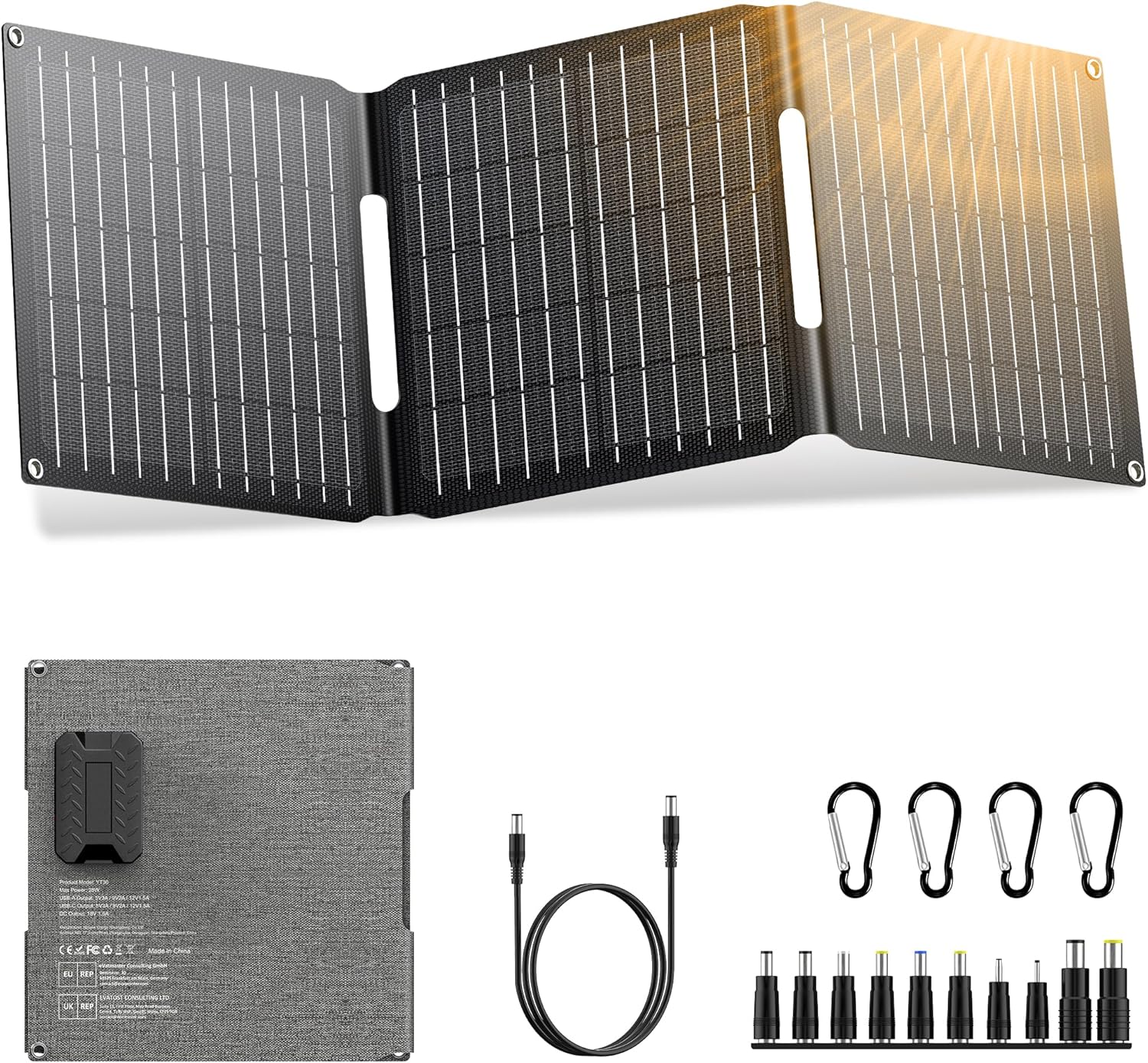
Specifications table — key details at a glance
Below is a clear breakdown so you can quickly see whether the specs match your needs.
| Feature | Specification |
|---|---|
| Product name | Portable Solar Panel Charger 30W, Foldable Solar Panel Kit with DC/USB C/USB A Output for Power Bank Station Phone Tablet, High Efficiency Waterproof Solar Panel for Camping RV Van Backpacking |
| Solar power (max) | 30W |
| DC output | 18V / 1.6A (30W max), DC5521 connector (φ5.5mm × 2.1mm) |
| USB-C output | 5V/3A, 9V/2A, 12V/1.5A (PD-like profiles) |
| USB-A output | QC3.0: 5V/3A, 9V/2A, 12V/1.5A |
| Panel surface | Polyester fabric with IP65 waterproof treatment |
| Connector box | Not waterproof (keep sheltered) |
| Folded size | 9.8 × 9.6 × 1.4 in |
| Unfolded size | 29.1 × 9.8 × 1.2 in |
| Weight | 1.65 lbs (~0.75 kg) |
| Typical use cases | Phones, tablets, power banks, small laptops (with appropriate DC input), cameras, small fans, portable power stations (check compatibility) |
| Warranty/service | Manufacturer after-sales support and customer service team available |
Design and build — how it feels and handles
The charger opens like a small book, and that design helps keep it compact. You’ll notice lightweight polyester on the exterior that’s treated for water resistance, and flexible solar panels inside. The build emphasizes portability rather than rugged industrial strength, so it’s ideal for people who prioritize low weight and stowability.
Foldable form factor — how compact is it?
When folded it’s roughly the size of a medium hardcover book and just over an inch thick, so you can slide it into most backpacks or suitcases without much trouble. That compactness makes it a real winner if you’re traveling light or have limited storage in an RV or van.
Material quality and durability
The panel surface uses high-quality polyester fabric with IP65 waterproofing, protecting the front face from spray and light rain. The stitching and seams are generally solid, but you’ll want to avoid heavy abrasion against rocks or rough edges. Because the junction box is not waterproof, you shouldn’t leave the unit outside in heavy rain or exposed overnight.
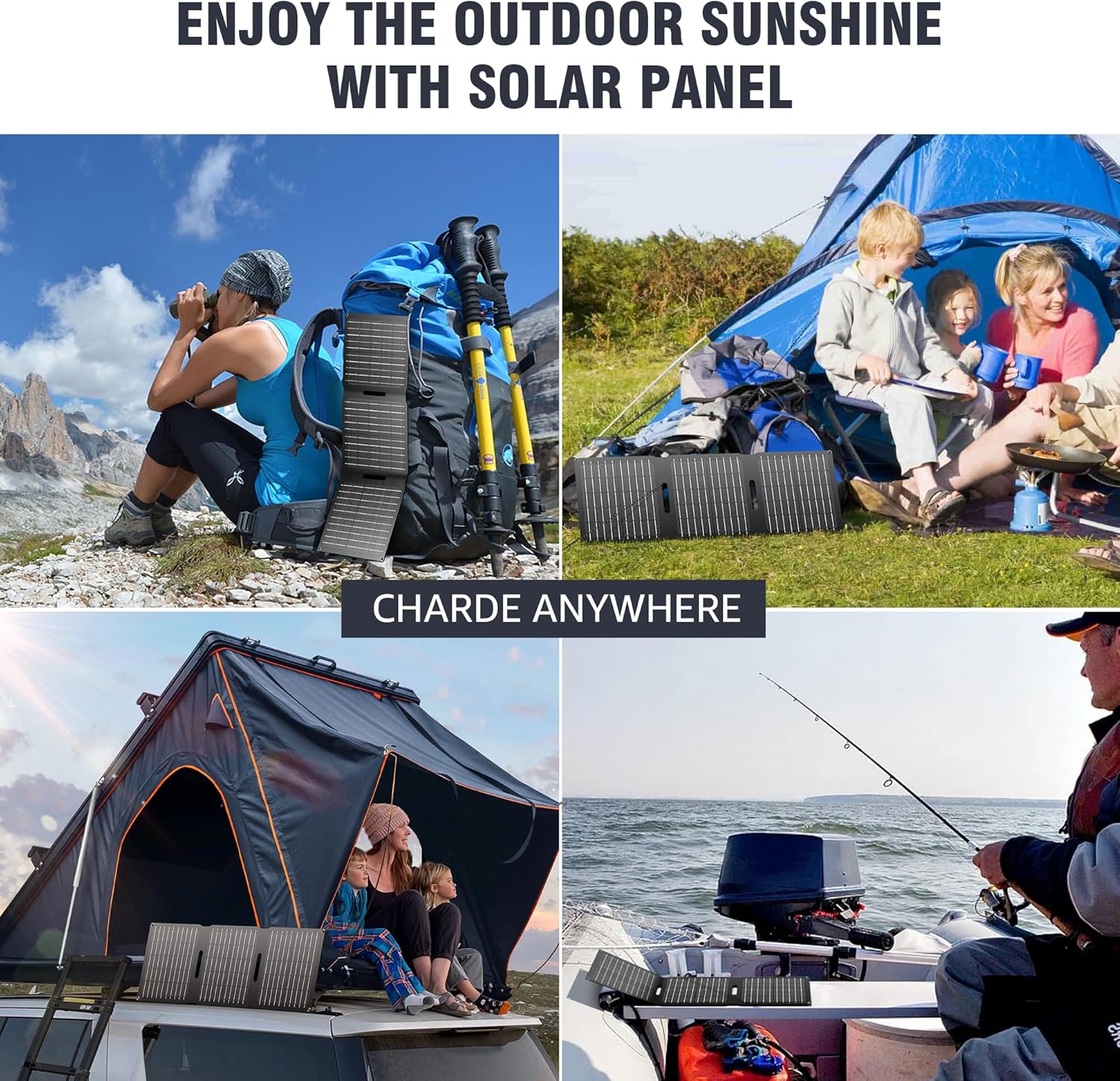
Portability — why this model works for travel
You can carry it in one hand and it won’t weigh you down. At 1.65 lbs it’s lighter than many hard-case portable panels, which makes it a go-to option if your priorities are mobility and space saving.
Packing and mounting options
The panel has loops and a slim profile that let you hang it from a backpack, strap it onto a roof rack, or secure it to a tent. You’ll want to use carabiners, bungee cords, or strap loops for stability. For best sunlight capture, you’ll need to position it so the panel faces the sun directly.
Outputs and compatibility — what devices you can charge
The charger offers three outputs: DC 18V/1.6A (30W max) via DC5521, USB-C with stepped voltage profiles, and USB-A QC3.0. That means you can charge modern phones quickly through USB-C, still support older USB-A phones, and use the DC port to charge compatible power banks or small devices that accept DC input.
USB-C and USB-A behaviour
USB-C supports 5V/3A, 9V/2A, and 12V/1.5A profiles, which is helpful for many phones, tablets, and some laptops that take power through USB-C. The USB-A QC3.0 port supports common quick-charge profiles as well, so you’ll get faster charging on compatible handsets. Remember that solar output varies — these numbers are maximums under ideal sunlight.
DC output use cases
The DC (18V/1.6A) port is useful for charging power banks, small portable power stations, and some laptops that accept barrel connector charging. Always confirm your device’s input voltage and connector type before connecting. The DC5521 is a common connector, but it won’t fit all DC-charging devices without an adapter.
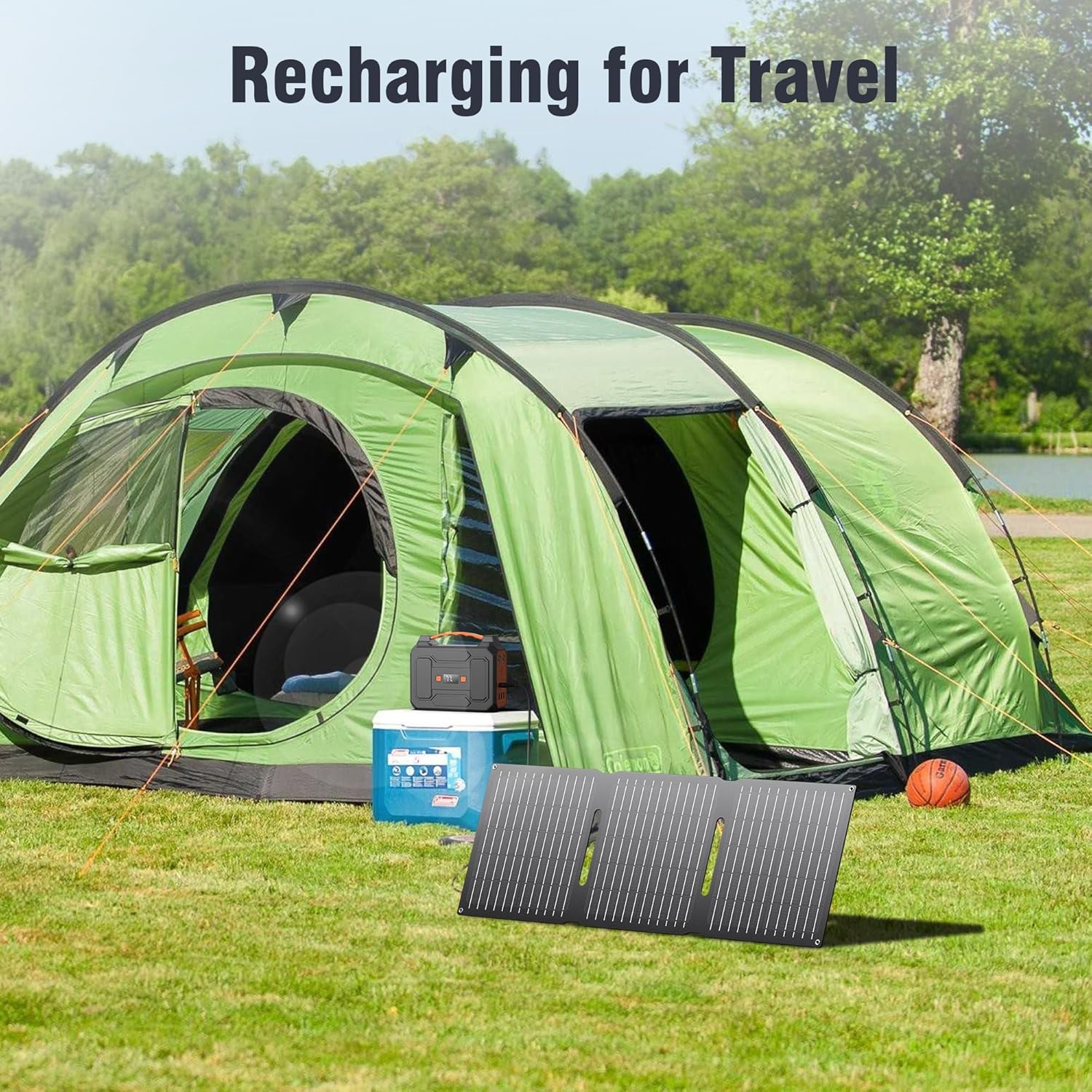
Real-world charging performance — what to expect
You get up to 30W peak in perfect sun conditions — clear sky, midday sun, correct orientation, and no shading. In real-world scenarios, output will often be lower due to angle, cloud cover, and temperature. For phones, you’ll commonly see near-full charging speeds on bright sunny days; tablets and small laptops may charge more slowly or require a charge via DC into a compatible power bank first.
Typical device charging times (approximate)
- Smartphone (modern, 3000–5000 mAh): 2–4 hours in strong sun via USB-C QC/PD-like profile.
- Power bank (20,000 mAh): 6–12 hours depending on sunlight consistency and the bank’s charging acceptance.
- Tablet: 3–6 hours in optimal sun; may be slower if the tablet draws more power.
- Small laptop (via DC into a compatible input): Variable — may top up laptop batteries slowly or charge a laptop partially.
Keep in mind these are broad estimates. Solar conditions, device efficiency, and cable quality will change real results.
Waterproofing and weather resilience — protections and limits
The panel surface is IP65 rated, meaning it resists water jets and light rain. That coating helps prevent water damage to the photovoltaic surface and keeps the unit functional after exposure to splashes and damp conditions.
Important caution: junction box is not waterproof
The connector box that houses the outputs and electronics is not waterproof. You must keep that box out of direct rain or heavy moisture. If it gets wet, you risk shorting the electronics and voiding your ability to use the charger until it’s dried and possibly serviced.
Setup and usage — step-by-step suggestions
You’ll get the best performance if you orient the panel perpendicular to the sun, remove shadows, and use short, high-quality cables. Here’s a simple routine:
- Unfold and flatten the panel on a surface that faces the sun.
- Angle it so the panel plane is perpendicular to the sun’s rays for maximum capture.
- Connect your device with the right cable and appropriate adapter (DC5521 for DC, USB-C for modern devices).
- Monitor device charging and reposition as needed as the sun moves.
Best times to charge
Mid-morning to early afternoon (roughly 9am–3pm) tends to be most productive, with peak performance near solar noon. Cloudy conditions will reduce output significantly.
Accessories and extras — what you might need
You’ll probably want a few extras to make the experience smoother: a short, sturdy USB-C cable, a carabiner or strap for mounting, adapters for DC connector compatibility with your power bank or laptop, and a small pouch to protect the junction box when not in use.
Recommended additions
- USB-C cable that supports PD/QC current ratings.
- DC adapter leads if your portable power station uses a different barrel connector.
- Lightweight, weatherproof cover or small dry bag to store the connector box when not in use.
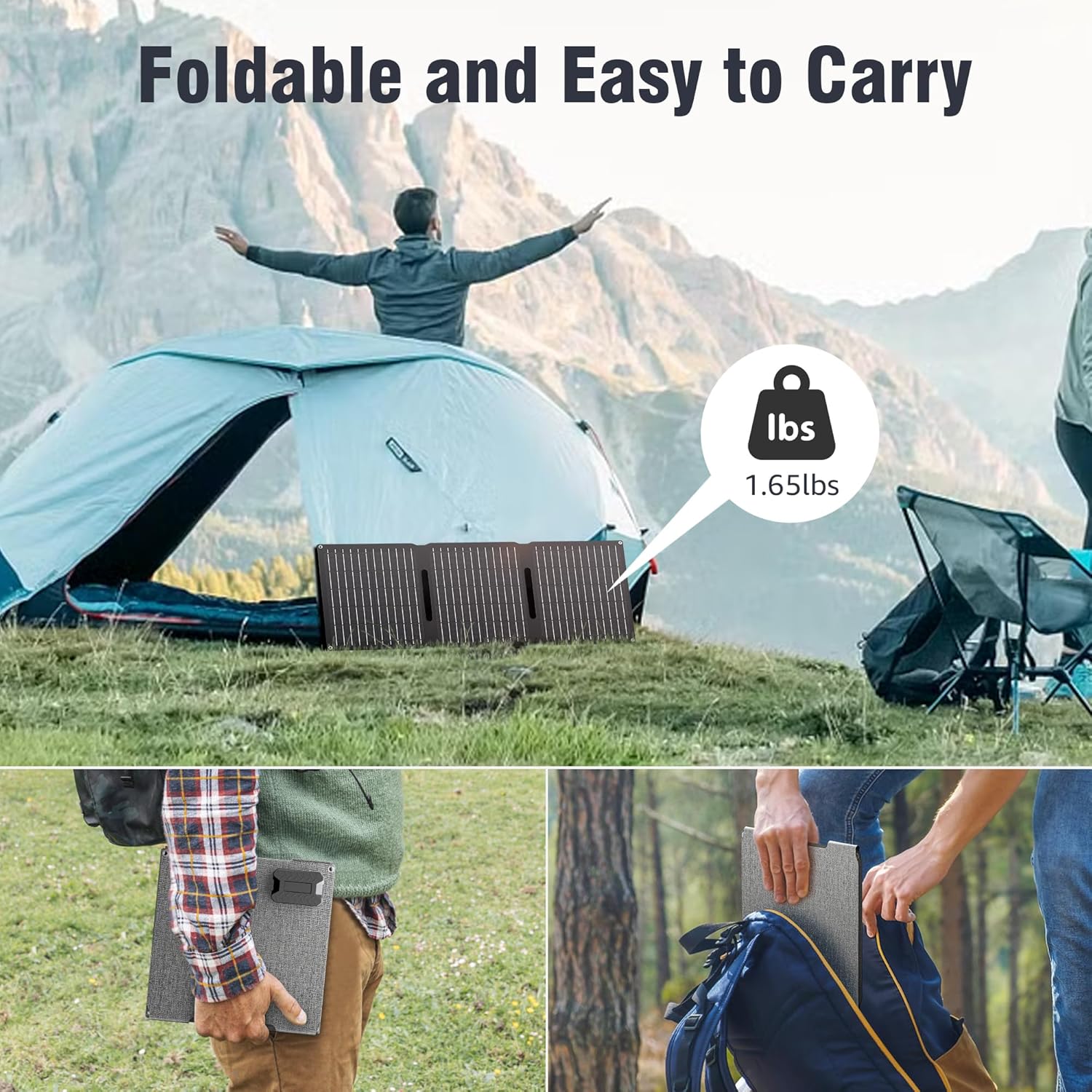
Use cases — where this panel shines
This panel is great for day hikes, weekend camping trips, RV roof-side charging, vanlife, and emergency kits. If you travel with a single phone, camera, or small power bank, it’s an ideal companion for topping off batteries and staying powered.
Camping and backpacking
You’ll value the low weight and compact folded size on backpacking trips. Strap it to your pack during the day to charge, or set it up at camp to keep devices ready for navigation, photos, and lights.
RV, van, and car camping
In a van or RV, you can attach it to a window, a dashboard, or a roof-mounted rack (securely) to supplement your main power system or keep small devices running without turning on the vehicle.
Emergency preparedness
Put this in an emergency kit to charge phones, radios, and lights during outages. Remember to keep the junction box sheltered and store it in a dry place until needed.
Pros and cons — a practical look
You deserve an honest list so you can decide.
| Pros | Cons |
|---|---|
| Extremely portable and lightweight | Connector box is not waterproof — requires care |
| Multiple outputs (DC, USB-C, USB-A) — versatile | Peak 30W output limits use with high-draw devices |
| IP65 treated panel face resists spray and light rain | Performance depends heavily on sun conditions |
| Easy to pack and store | Not as rugged as some hard-case solar panels |
| Affordable option for casual outdoor users | May require adapters for some power stations/laptops |
Tips to maximize performance
You’ll get better results if you pay attention to a few small details. First, keep the panel perpendicular to the sun. Second, avoid shading even by small objects — a shadow over part of the panel can drastically reduce output. Third, use short, quality cables to avoid voltage drop.
Angle and orientation
If you can, adjust the panel’s angle throughout the day to maintain a direct face to the sun. Fixed positions work okay but moving it will boost cumulative energy collection.
Keep it clean
Dust, dirt, and salt spray reduce performance. Wipe the panel surface gently with a damp cloth and avoid abrasive cleaners. Dry it thoroughly before folding and storing.
Safety and compatibility notes
Always confirm your device’s input specifications before connecting. The DC port is 18V/1.6A and uses DC5521; mismatching voltages can damage devices. Also be mindful of voltage fluctuations in low-light conditions — some devices may not negotiate charging properly in inconsistent sunlight.
Avoid electrical mishaps
Don’t leave the connector box exposed to rain. If you must charge during damp conditions, shelter the box with a waterproof pouch or place it inside a dry bag while allowing the panel face to collect sunlight.
Comparison with other panels in its class
Compared to rigid 60W+ panels, this unit is lighter and more portable but offers less continuous power. Against other foldable 20–40W panels, its multi-output configuration and DC port are strong pluses. If you want raw power for heavy loads, you’ll need larger panels and a battery or power station to store energy.
How it stacks up for casual users
If your typical needs are phones, cameras, and small power banks, this panel is a balanced choice: affordable, portable, and versatile. For power-hungry laptops or long-term off-grid living, you’ll want something larger plus a battery.
Maintenance and storage
Store the panel folded in a cool, dry place. Avoid leaving it folded with dirt trapped inside. Periodically inspect the seams, cables, and connectors for wear. If you notice fraying on the fabric or loose wires, stop using it until repaired or replaced.
Cleaning steps
Use a soft, damp cloth and mild soap if needed. Do not submerge the connector box; clean it only with a dry cloth and keep it sealed and dry.
After-sales service and warranty
The manufacturer offers after-sales support and a customer service team. You should register your product if registration is available and keep your receipt for warranty claims. If you encounter problems, contact support promptly and describe the issue, the conditions of use, and any troubleshooting steps you tried.
Troubleshooting common issues
If the panel isn’t charging well, check positioning, cleanliness, and shading. If a specific port won’t charge, try another port to isolate whether it’s the device, the cable, or the port. For intermittent charging, ensure the connector box is dry and that cables are firmly seated.
What to try first
- Move the panel to direct sunlight and re-angle it.
- Swap cables to rule out cable damage.
- Test with a different device to eliminate device-specific problems.
Environmental considerations
Using this solar charger reduces reliance on grid electricity when you’re outdoors, lowering your carbon footprint during trips. The unit’s long-term sustainability depends on responsible care — proper storage and avoiding exposure to extreme elements will extend its lifetime.
FAQs — quick answers to likely questions
- Can you charge a laptop directly? Possibly, if the laptop accepts 18V via a compatible DC5521 input or via USB-C PD at the matching voltages. Confirm your laptop’s charging specs first.
- Is the unit waterproof? The panel surface is IP65 water-resistant, but the connector box is not waterproof. Don’t leave it out in heavy rain.
- Will it charge in cloudy conditions? It will still produce some power, but output drops significantly under cloud cover. Expect much longer charge times.
- Can it charge a 20,000 mAh power bank? Yes, but charging will take several hours and depends on consistent sunlight.
Who should buy this solar panel?
You should consider this panel if you want a highly portable, light solar charger for phones, small electronics, or for topping up power banks during outdoor trips. It’s best for casual to moderate users who prioritize convenience and packability over maximum output.
Who should look elsewhere
If you need continuous, heavy-duty power for long-term off-grid living, larger portable panels paired with a battery or power station will be a better fit. Likewise, if you plan to use gear in heavy rain regularly, a more rugged, fully waterproof system would be preferable.
Final verdict — practical takeaways
You’ll find the Portable Solar Panel Charger 30W a thoughtful balance of portability, multi-port versatility, and everyday outdoor usefulness. It’s a strong option if you want a simple way to keep small devices charged on day trips, in your RV, or during emergency use — provided you take care to protect the non-waterproof connector box and manage realistic expectations about solar output. For casual outdoor users and minimalists who value weight and size, this panel is a solid, affordable tool to add renewable energy to your kit.
If you want, I can help you compare this model against specific competitors or walk you through selecting the right adapters and cables for your devices. Which devices do you plan to charge most often?
Disclosure: As an Amazon Associate, I earn from qualifying purchases.